
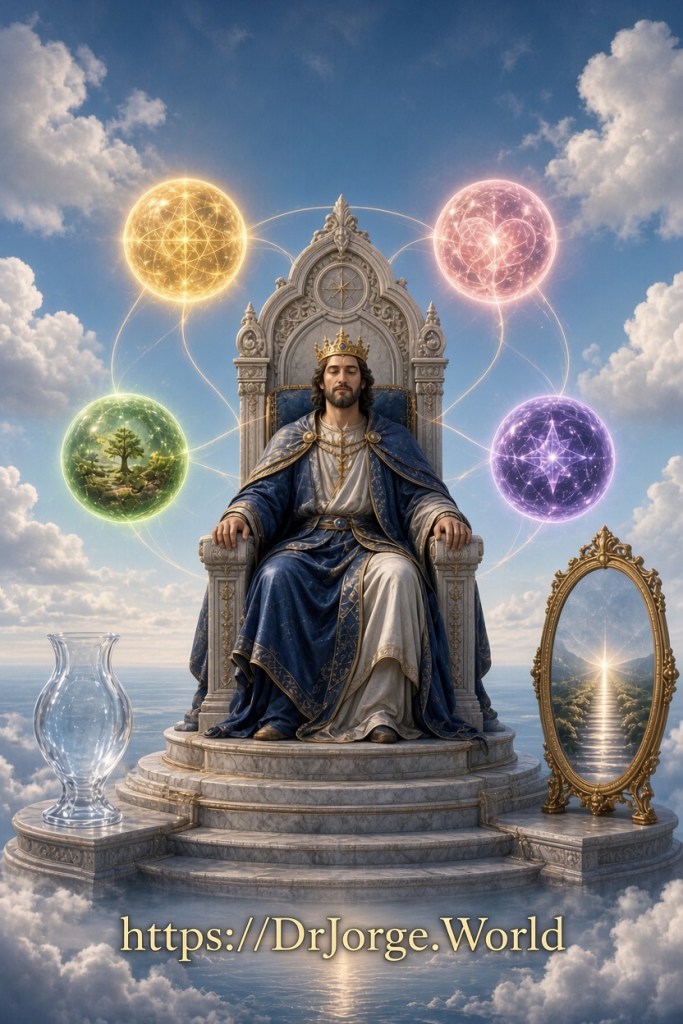
Law 2 of Personal Sovereignty: Contemplating Emotions as Clouds in the Sky
There are moments in life when the ground beneath our feet seems to dissolve completely. These are the instants of turmoil, the deep crises, the inevitable ruptures and drastic changes that fracture our neurochemical routine and strip us of all emotional anaesthesia. On those stormy days, when the brain’s amygdala switches on at maximum alert and the pain is felt with real physical rawness, we find ourselves helpless before an inescapable existential crossroads. The universe withdraws its patches and places us in front of an implacable mirror: it is the definitive opportunity to choose between growing or shrinking, between transmuting pain into light or retreating into the protective shadow of fear, between evolving towards our personal sovereignty or involuting by repeating the automatic scripts of our ancestral traumas.
True freedom does not consist in simulating a rigid and invulnerable strength that escapes feeling, but in learning to govern one’s own helm in the middle of the swell. This manifesto is not a collection of empty pieces of advice for turning the page immediately; it is a clinical, philosophical and somatic roadmap for inhabiting factual solitude with dignity. Through the twelve laws of personal sovereignty, we explore how to integrate our four vital spheres — Reason, Emotion, Body and Spirit — in order to stop seeking external lead life-jackets and finally consolidate ourselves as the sovereign authors of our own light.
In the first law we established the condition of possibility for all real sovereignty: the conscious integration of the four spheres. Without that alignment, any attempt to manage inner life becomes a fragmented exercise and, in the long run, unsustainable. The second law now descends to the concrete terrain of one of those spheres — the emotional — and offers us a precise and liberating image: Contemplating Emotions as Clouds in the Sky.
Administering emotions does not mean controlling them, repressing them or freezing them in the basement of the mind. Sovereignty consists in allowing the emotion to exist and flow, observing it as a cloud that crosses the sky. The defensive bunker tries to dissolve the cloud or pretends that the sky is clear by force; the sovereign accepts the storm, cries if necessary, knowing that he is the stable firmament that remains while the tempest passes.
Emotion as an internal meteorological phenomenon
The metaphor of the clouds is not poetic by chance. It is clinical, neuroscientific and existential at the same time. Emotions, like cloud formations, arise from prior conditions (atmospheric pressure, humidity, temperature; or, in our case, losses, perceived threats, activated memories, neurochemical changes). They appear, move, change shape, sometimes discharge rain or lightning, and eventually dissolve or drift away. The most common — and the most costly — error is to confuse the cloud with the sky.
When we identify completely with the emotion of the moment (“I am this sadness”, “I am this rage”, “I am this emptiness”), we turn a passing phenomenon into a fixed identity. The sky disappears behind the cloud and we remain trapped in a permanent climate of storm. By contrast, when we learn to observe the emotion as something that occurs in us, but that is not us, we recover the space of the firmament. That space is sovereignty.
This distinction is fundamental because contemporary culture pushes us towards two equally fragmenting extremes. On the one hand, the mandate to “control emotions”, which in practice usually translates into repression, intellectualisation or anaesthesia. On the other, the mandate to “feel everything intensely and express it without filter”, which can lead to overflow, chronic reactivity or retraumatisation. Neither of these poles is sovereign. The sovereign neither dissolves the cloud nor drowns in it: he contemplates it.
From the defensive bunker to the acceptance of the storm
The defensive bunker is the most widespread strategy. It consists in trying to dissolve the cloud by force (minimising, rationalising prematurely, distracting oneself, hyper-activating) or in pretending that the sky is clear (“I’m already fine”, “it doesn’t affect me”, “one has to move on”). These manoeuvres can offer short-term relief, but they carry a high price: the unprocessed emotion is stored in the body, turns into chronic tension, automatic behavioural patterns or symptoms that appear later with greater intensity.
The sovereign, by contrast, accepts the storm. He cries if necessary. He feels the rage without acting it impulsively. He allows sadness to occupy space without turning it into a permanent victim narrative. He knows that he is the stable firmament. This acceptance is neither passivity nor resignation. It is an active form of internal government: the emotion is given the right to exist, it is observed with curiosity and compassion, and trust is placed in its transitory nature.
This posture requires the integration of the four spheres that we explored in the first law. Reason brings the discernment necessary not to confuse the cloud with the sky. The body offers the somatic anchoring that allows one to feel without overflowing (the breath, the posture, the sensation of the feet on the ground). Spirit sustains the confidence that beyond the storm there is continuity and meaning. Without that integration, contemplation becomes impossible: either it is intellectualised (isolated reason), or dramatised (isolated emotion), or fled through movement (isolated body), or spiritualised prematurely (bypass spirit).
Multidimensionality applied to emotional life
The same multidimensional logic that I have developed throughout my academic work on state sovereignty, territorial disputes and cosmopolitanism applies here with full coherence. On the international plane I have insisted that sovereignty is never a unidimensional or absolute phenomenon. There exists a plurality of agents, contexts, realms and levels that interweave. Pretending to govern a complex territory from a single dimension generates chronic and irresolvable conflicts.
Exactly the same occurs with emotional life. Emotion is not an isolated phenomenon that can be managed solely from psychology, or solely from neuroscience, or solely from spirituality. It is a multidimensional event: it has physiological correlates (body), interpretive ones (reason), affective ones (emotion properly speaking) and existential ones (spirit). When we try to approach it from a single sphere, we reproduce the error of the State that pretends to exercise absolute sovereignty without recognising the plurality of actors and realities at play.
Contemplating emotions as clouds is therefore an act of multidimensional sovereignty. It recognises the complexity of the phenomenon without pretending to reduce it. It allows each dimension to contribute what corresponds to it: the body registers and regulates, reason names and contextualises, emotion informs and moves, spirit sustains the continuity of the firmament. No sphere dominates in an exclusionary way. All co-participate.
This vision also connects with the notion of “pluralism of pluralisms” that I have developed in my monographs. Just as in the international realm there exist multiple legitimate agents (individuals, communities, States) that can play diverse roles (hosts, participants, spectators), in the internal realm there exist multiple “voices” or dimensions that deserve to be heard without any one of them hijacking the government of the whole. Emotion is one of those voices. Powerful, necessary, informative… but not absolute sovereign.
The practice of contemplation
How does this law translate into everyday life, especially in the middle of a real crisis?
First, one cultivates the capacity to notice the appearance of the cloud. This requires a minimum of presence. Many times the emotion is already acting (in the form of tension, reactivity, avoidance) before consciousness registers it. Simple practices of internal check-in throughout the day help to shorten that interval.
Second, one names without judging. “This is sadness.” “This is fear.” “This is rage.” The act of naming activates prefrontal circuits that modulate the intensity of the amygdalar response. It is not a matter of labelling in order to control, but of recognising in order not to identify.
Third, one allows the movement of the emotion. Tears, trembling, sound, controlled bodily movement can be legitimate ways of letting the cloud discharge. The key lies in accompanying that movement without turning it into dramatic performance or into a narrative of identity.
Fourth, one maintains the anchoring in the firmament. While the emotion moves, one cultivates the awareness that there is a wider space that contains it: the breath, the sensation of the body, the continuity of one’s own existence beyond this moment. That space is the sky.
Fifth, one trusts in impermanence. Every cloud passes. Even the most intense storms move on. This trust is not naïve: it is built through the repeated experience of having crossed previous storms and having verified that the firmament remains.
What this law is not
It is important to clear up misunderstandings. Contemplating emotions as clouds does not mean:
- Minimising real pain or telling oneself “it’s not that bad”.
- Avoiding necessary action when the emotion signals a situation that requires a response.
- Becoming a cold and disconnected observer.
- Using the metaphor as a technique of spiritual bypass (“everything is illusion”).
- Demanding of oneself a perfect and immediate equanimity.
It means, rather, developing the capacity to feel fully without losing the centre. To cry without becoming the tear. To become angry without becoming the rage. To cross the emptiness without confusing it with one’s own essence.
Emotion within the framework of the twelve laws
This second law articulates organically with the others. The integration of the four spheres (Law 1) is the condition that makes contemplation possible. Vital continuity as a behavioural anchor (Law 3) offers the framework of habits that sustains the firmament while the storm passes. Emotional abstinence is not regression (Law 4) reminds us that acute pain after a loss is often a real neurochemical withdrawal syndrome that must be crossed with bodily patience. The triad of emptiness (Law 5) helps us distinguish being alone from feeling alone and from the lead life-jacket. And so on.
Without the capacity to contemplate emotions as clouds, the other laws lose operability. Whoever identifies completely with every emotional wave ends up acting from reactivity and not from sovereignty. Whoever systematically represses emotions accumulates a pressure that, sooner or later, explodes or somatises.
Towards an internal climatic sovereignty
Ultimately, this law invites us to become wise meteorologists of our own internal climate. We do not control the clouds (we cannot decide which emotions will appear or with what intensity). We can decide how we relate to them. We can learn to read the sky, to distinguish between a passing drizzle and a storm that requires preparation, to know when to take shelter and when to go out and walk in the rain.
This capacity is profoundly liberating. It returns to us the dignity of not being permanent victims of our mood. It allows us to inhabit factual solitude without turning it into an identity abyss. It gives us the possibility of choosing, again and again, the path of light at the crossroads of the mirror: not because we deny the pain, but because we know that the pain, however intense it may be, is a cloud that crosses the sky of a firmament that remains.
Personal sovereignty is not the absence of difficult emotions. It is the capacity to allow them to exist, to observe them with clarity and to trust that, while they pass, we continue to be the wide, stable and conscious sky that contains them.
This is the second law. Upon it the ones that follow are built. But without it, the integration of the four spheres remains incomplete, and the government of one’s own helm becomes impossible in the middle of the real swell. Contemplate the next cloud that appears. Do not try to dissolve it. Do not become it. Observe it. Breathe. Remember that you are the firmament. And let it pass.
Previous Posts
AUTHOR’S SAMPLE PEER-REVIEWED ACADEMIC RESEARCH (FREE OPEN ACCESS):
State Sovereignty: Concept and Conceptions (OPEN ACCESS) (IJSL 2024)
AUTHOR’S PUBLISHED WORK AVAILABLE TO PURCHASE VIA:
Thursday 8th October 2026
Dr Jorge Emilio Núñez
X (formerly, Twitter): https://x.com/DrJorge_World


[…] The 12 Laws of Self-Sovereignty Law 1 of Personal Sovereignty: The Integration of the Four Spheres (Necessary Condition vs. Sufficient Condition) Law 2 of Personal Sovereignty: Contemplating Emotions as Clouds in the Sky […]
LikeLike