
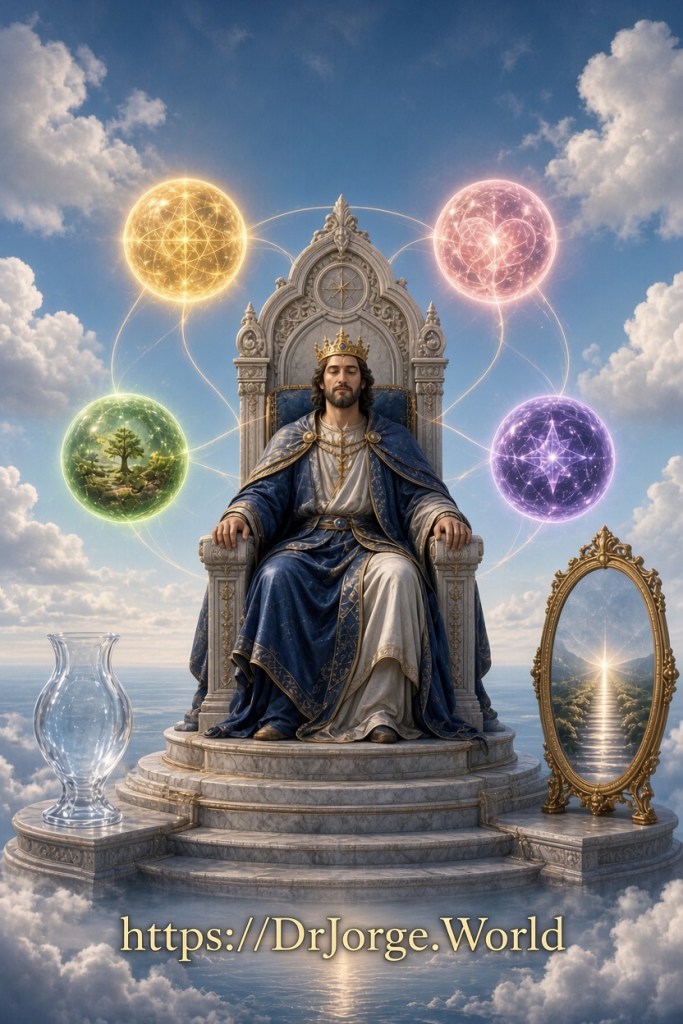
The 12 Laws of Self-Sovereignty
There are moments in life when the ground beneath our feet seems to dissolve entirely. These are the intervals of profound anxiety, the acute crises, the unavoidable break-ups, and the drastic changes that fracture our neurochemical routines and strip away all emotional anaesthesia. In those stormy days, when the brain’s alarm is triggered at its highest frequency and pain is felt with raw physical density, we find ourselves standing bare before an inescapable existential crossroads. The universe removes its temporary patches and places us before an unyielding mirror: it is the ultimate choice to either expand or shrink, to transmute pain into light or retreat into the protective shadow of fear, to evolve towards personal sovereignty or to regress by repeating the automatic scripts of our ancestral wounds.
True freedom does not consist of simulating a rigid, invulnerable toughness that flees from feeling, but of learning to govern one’s own helm in the midst of the swelling tide. This manifesto is not a collection of hollow clichés demanding that you move on immediately; it is a clinical, philosophical, and somatic roadmap to inhabiting factual solitude with absolute dignity. Through the following twelve laws—each of which we will explore in depth in upcoming posts—we will examine how to integrate our four vital realms (Reason, Emotion, Body, and Spirit) so we may stop clinging to external, heavy lifesavers and firmly establish ourselves, at last, as the sovereign authors of our own light.
1. The Integration of the Four Realms (Necessary vs. Sufficient Condition)
Personal sovereignty demands the absolute alignment of your four essential realms: Reason, Emotion, Body, and Spirit (or Soul). In simple terms, each of these realms is a necessary condition, but none on its own is sufficient. Anyone who takes refuge solely in physical activity or intellect to avoid feeling fragments their own domain. True freedom is born exclusively from the conscious integration of all four.
2. Observing Emotions as Clouds in the Sky
Managing emotions does not mean controlling, repressing, or freezing them in the basement of the mind []. Sovereignty consists of allowing the emotion to exist and flow, observing it like a cloud crossing the sky []. The defensive bunker attempts to dissolve the cloud or force a fake clear sky; the sovereign person accepts the storm, weeping if necessary, knowing that they are the stable firmament that remains while the weather passes.
3. Vital Continuity as a Behavioural Anchor
When the emotional impact is devastating and energy is flat, mental strength does not consist of simulating a false toughness, but of maintaining the dignity of your essential habits. Continuing to attend to your health disciplines, nourishing your body, and keeping your home in order whilst experiencing the clean pain of loss is not a robotic disconnection; it is the commitment of a king who refuses to abandon the care of his own kingdom in the midst of a crisis.
4. The Brain’s Alarm Responds to the Body, Not to Logic
The acute pain and physical emptiness that strike after a discard are neither depression nor a step backward. They are the real neurochemical withdrawal syndrome of a nervous system being biologically purged of a substance it was habituated to for months. Cellular hangover is tolerated with bodily patience and rest, not with mental judgment.
5. The Triad of Emptiness (Factual Solitude, the Feeling of Loneliness, and Lead Lifesavers)
Mental sovereignty requires discerning three distinct states in the face of absence with absolute clinical precision:
- Being Alone (Factual Solitude): A purely geographical and physical fact. A purified, neutral space free from external interference, constituting the indispensable framework for rebuilding one’s own helm.
- Feeling Lonely (Emotional Reality): A natural response of the amygdala to the loss of a neurochemical routine. It is an affective storm that must be navigated and managed like the clouds in Law 2, without judgment or camouflage.
- Lead Lifesavers (Evasion Mechanisms): Any desperate escape designed to avoid looking into the mirror of Law 11. This includes both relational anaesthetics (casual encounters, toxic company, addictions) or behavioural anaesthetics (obsessive chores, cleaning, or punishing work schedules to overload body and mind). Anyone who saturates their calendar to avoid feeling does not inhabit factual solitude; they are simply fleeing from themselves on a mechanical treadmill.
6. The Law of the Clean Vessel (Vaciar)
For life to deliver a flexible, fertile, and reciprocal future, the vessel of your soul must be completely emptied of old energy. Radical contact zero is not a game of pride; it is the sovereign decree of territorial protection, ensuring no crumb from the past reinfects your clean present.
7. The Brain’s Alarm Responds to the Body, Not to Logic
The amygdala (the brain’s panic radar) does not comprehend intellectual reasoning when triggered in crisis. To calm anxiety, one must speak the language of the body through somatic medicine: the rhythmic water of a swimming pool, being wrapped tightly in fresh sheets, and the comfort of music that makes you feel safe.
8. The Value of Exclusive Co-Regulation
Externalising pain and deconstructing the puzzle through speech is a healthy clinical mechanism, but it must only be done with high-frequency people who validate you without judgment. One must actively filter out those who minimise your process or demand that you “move on immediately” due to their own haste, insecurities, unresolved underlying issues or ignorance.
9. The Mirror of Compulsive Repetition
The subconscious tends to colours and involuntarily recreate the scenarios of our deepest childhood wounds (such as seeking validation from an absent father figure). We attract profiles that reflect that exact same distance, driven by the fantasy that “this time we will make them stay.” Identifying the pattern is what breaks the ancestral spell permanently.
10. No One Can Give What They Do Not Have Within
Pouring your truckload of gold into a vessel that explicitly warns you it does not love itself is an act of self-sabotage. It is not that you lack resources; it is about understanding that no amount of unconditional love is ever enough to fill someone who has chosen to live locked inside the gélid cell of their own fears.
1. The Crossroads of the Mirror Faced with Inevitable Emptiness
When a relationship breaks, silence is imposed or crises hit, the universe removes all anaesthesia and places us before an unyielding mirror. In that instant of absolute emptiness, the human being faces their ultimate existential crossroads: crossing through the mirror towards the Light (opening the heart chakra, embracing the vulnerability of emotions, and elevating the spirit) or retreating and embracing Fear (using the rigid justifications of reason and the hyperactivity of the body to flee from oneself). Sovereignty lies in sustaining the silence to allow each soul to choose its own evolutionary destiny.
12. You Are Your Own Unshakeable Certainty
Ultimate personal sovereignty is achieved the day you discover that your salvation, your worth, and your peace do not depend on the logistics of a flight, the approval of your parents, or the physical presence of a third party. Your greatest crowns are built by you alone, inhabiting your own throne in perfect integrity. You are the new way forward.
AUTHOR’S SAMPLE PEER-REVIEWED ACADEMIC RESEARCH (FREE OPEN ACCESS):
State Sovereignty: Concept and Conceptions (OPEN ACCESS) (IJSL 2024)
AUTHOR’S PUBLISHED WORK AVAILABLE TO PURCHASE VIA:
Wednesday 16th September 2026
Dr Jorge Emilio Núñez
X (formerly, Twitter): https://x.com/DrJorge_World
 Dr Jorge's World