
The 12 Laws of Self-Sovereignty
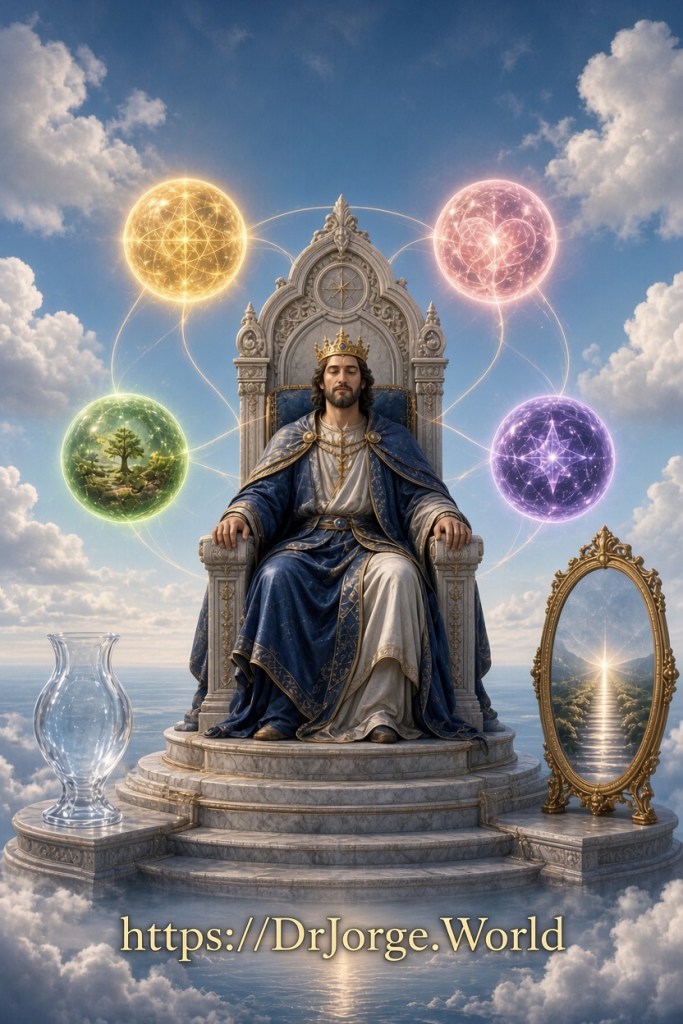
Law 1 of Personal Sovereignty: The Integration of the Four Spheres (Necessary Condition vs. Sufficient Condition)
There are moments in life when the ground beneath our feet seems to dissolve completely. These are the instants of turmoil, the deep crises, the inevitable ruptures and drastic changes that fracture our neurochemical routine and strip us of all emotional anaesthesia. On those stormy days, when the brain’s amygdala switches on at maximum alert and the pain is felt with real physical rawness, we find ourselves helpless before an inescapable existential crossroads. The universe withdraws its patches and places us in front of an implacable mirror: it is the definitive opportunity to choose between growing or shrinking, between transmuting pain into light or retreating into the protective shadow of fear, between evolving towards our personal sovereignty or involuting by repeating the automatic scripts of our ancestral traumas.
True freedom does not consist in simulating a rigid and invulnerable strength that escapes feeling, but in learning to govern one’s own helm in the middle of the swell. This manifesto is not a collection of empty pieces of advice for turning the page immediately; it is a clinical, philosophical and somatic roadmap for inhabiting factual solitude with dignity. Through the twelve laws of personal sovereignty, we explore how to integrate our four vital spheres — Reason, Emotion, Body and Spirit — in order to stop seeking external lead life-jackets and finally consolidate ourselves as the sovereign authors of our own light.
The first of these laws, the condition of possibility of all the others, is the Integration of the Four Spheres.
Sovereignty as multidimensional alignment
Personal sovereignty demands the absolute alignment of your four essential spheres: Reason, Emotion, Body and Spirit (or Soul). In mathematical terms, each of these dimensions is a necessary condition, but none of them separately is sufficient. Whoever takes refuge solely in physical activity or in the intellect in order not to feel, fragments their own structure. True freedom is born only from the conscious integration of the four.
This formulation is not a motivational slogan. It is a rigorous affirmation that deliberately connects with the multidimensionality that has characterised all my academic and intellectual work over more than two decades. In my research on state sovereignty, territorial disputes and cosmopolitanism — from Sovereignty Conflicts and International Law and Politics (2017), through Territorial Disputes and State Sovereignty (2020) to Cosmopolitanism, State Sovereignty and International Law and Politics: A Theory (2023/24) — I have insisted that sovereignty is never a unidimensional phenomenon. Absolute, monolithic and exclusionary sovereignty of the kind that classical international law and power politics pretended to construct does not exist. What exists instead is a pluralism of pluralisms: a multiplicity of agents (individuals, communities, States), of contexts (local, regional, international), of realms (legal, ethical, political, cultural, economic) and of levels of interaction that interweave dynamically.
What I now propose is to apply that same multidimensional logic to the most intimate and non-transferable territory: the self. Just as a State that pretends to exercise absolute sovereignty over a territory without considering the populations that inhabit it, international norms, economic interests or geopolitical realities ends up trapped in irresolvable conflicts, the individual who tries to govern himself from a single sphere — only from reason, only from emotion, only from the body or only from a disembodied spirituality — constructs a fragile internal regime, prone to collapse at the first real storm.
The four spheres as necessary conditions
Reason is the capacity to discriminate, to analyse, to name what is happening, to draw maps and to project scenarios. It allows us to distinguish between being alone (a geographical fact) and feeling alone (an emotional response), between clean pain and addictive suffering, between real need and the lead life-jacket. Without reason we become hostages to impulses and inherited narratives. But reason alone is insufficient. The hyper-developed intellect that takes refuge in endless analysis in order not to feel is a sophisticated bunker. It produces cognitive clarity, but generates somatic and spiritual disconnection. It is the equivalent of a State that drafts perfect constitutions while ignoring the suffering of its population.
Emotion is the oldest and most precise signalling system we possess. It informs us about loss, about threat, about desire and about connection. Administering emotions does not mean controlling them, repressing them or freezing them in the basement of the mind. Sovereignty consists in allowing the emotion to exist and flow, observing it as a cloud that crosses the sky. Without emotion we become efficient robots or disconnected cynics. But emotion alone is insufficient. Whoever identifies completely with the affective storm drowns in it. The amygdala does not distinguish between real danger and an activated memory; it needs the other spheres in order to be regulated.
The Body is the primary territory of sovereignty. It is the place where history is inscribed in the form of muscular tension, breathing patterns, defensive postures and cellular memories. When the emotional impact is devastating, strength does not consist in simulating a false fortitude, but in maintaining the dignity of essential habits: nutrition, movement, rest, hygiene of the environment. The body speaks a language that logic does not understand. The amygdala responds to the body, not to intellectual reasonings. That is why somatic practices — rhythmic water, firm wrapping, conscious walking, regulated breathing — are not optional complements; they are technology of internal government. Without an integrated body, sovereignty is an abstract idea. But the body alone is also insufficient. Hyper-training, work hyper-activity or saturation with domestic tasks can become behavioural anaesthetics: sophisticated ways of not looking in the mirror.
Spirit (or Soul) is the dimension that sustains continuity beyond the punctual crisis. It is the capacity to inhabit silence without collapsing, to sustain vulnerability without losing dignity, to recognise that emptiness is not only absence but also potential space. It is what allows us to choose the light at the crossroads of the mirror: to open the heart, to embrace vulnerability and to elevate ourselves, rather than retreating into fear with rigid justifications of reason or hyper-activity of the body. Without this dimension, life is reduced to stimulus management and survival. But spirit disconnected from the body, from emotion and from reason easily becomes escape spirituality, bypass spirituality that pretends to “rise” by skipping the necessary somatic and emotional work.
Each sphere is necessary. None is sufficient. Sovereignty emerges only from their conscious integration.
Necessary condition versus sufficient condition: the logic of integrity
In logic and in mathematics, a necessary condition is that without which the result cannot be produced. A sufficient condition is that which, by itself, guarantees the result. The integration of the four spheres is the only sufficient condition for personal sovereignty. Each individual sphere is necessary, but none reaches it.
This distinction is crucial because contemporary culture constantly pushes us towards unidimensional solutions. “Think positive” (distorted reason). “Feel your emotions” (emotion without container). “Train harder” (body as anaesthetic). “Meditate and let go” (spirit of bypass). Each of these slogans, in isolation, produces fragmentation. The individual ends up living in an internal failed State: with formalised institutions (mental habits) but without popular legitimacy (emotional disconnection), with military force (bodily discipline) but without social cohesion (lack of spiritual integration), or with elevated spiritual rhetoric but without the capacity to govern everyday territory.
Fragmentation has observable clinical consequences. Whoever takes refuge only in the intellect develops a somatic disconnection that, over time, manifests as chronic anxiety, exhaustion or stress-related illnesses. Whoever identifies only with emotion remains trapped in cycles of reactivity and retraumatisation. Whoever hyper-mobilises the body in order not to feel ends up with injuries, adrenal exhaustion or collapse when the body can no longer sustain the flight. Whoever seeks only in the spiritual without anchoring in the other three spheres builds castles in the air that collapse at the first real loss.
Integration, on the contrary, generates real resilience. Not the resilience of invulnerability, but the resilience of one who can cross the storm because they know their own territory in all its dimensions. It is the personal equivalent of what in my work on shared sovereignty I have called “egalitarian sovereignty” or “pluralism of pluralisms”: an arrangement in which no agent dominates in an exclusionary way, but interdependence is recognised and authority is distributed in an equitable and functional manner.
Multidimensionality: from the State to the self
The connection between my academic work and this personal law is not metaphorical; it is structural. For years I have argued that state sovereignty cannot be understood in a unidimensional way (only legal, only political, only territorial). It must be analysed through multiple lenses: diverse agents (not only States, but also communities, individuals, corporations, international organisations), overlapping contexts, concurrent normative realms and levels of governance. The result is a vision of sovereignty as a relational and dynamic capacity, not as an absolute and exclusionary attribute.
Exactly the same operation is required in the personal realm. The internal “State” is not an absolute monarch (the rational ego or the dominant emotional impulse). It is a multidimensional system of governance in which reason, emotion, body and spirit must negotiate, co-regulate and align. When one sphere tries to monopolise power — when reason pretends to govern without consulting the body, or when emotion hijacks the entire system — an internal sovereignty conflict is produced analogous to the territorial disputes I have studied for decades: stagnation, chronic tension, impossibility of creative resolution and, eventually, acute crisis.
The integration of the four spheres is therefore the personal equivalent of what I have called “the paradigm shift from the unidimensional to the multidimensional”. Just as States can retain sovereignty and, at the same time, accommodate forms of legal cosmopolitanism and shared sovereignty, the individual can maintain deep autonomy and, at the same time, fully inhabit their vulnerability, their corporeality and their spiritual dimension.
How integration is practised
Integration is not a final state that is reached once and for all. It is a continuous practice, especially visible in moments of crisis. Some concrete orientations:
- Diagnosis of imbalance: In the face of any emotional or vital turbulence, ask yourself honestly: which sphere am I privileging and which am I neglecting or repressing? Am I thinking too much in order not to feel? Am I feeling without rational container or bodily anchoring? Am I hyper-activating the body? Am I “spiritualising” the pain in order not to go through it?
- Language of the body first: When the amygdala is activated, reason has limited access. One speaks first to the body (breathing, temperature, rhythmic movement, safe contact) in order to create the conditions of possibility for the emotion to be observed and for reason to intervene with clarity.
- Emotional observation without identification: The emotion is contemplated as a cloud. It is allowed to exist, it is named, it is given space, but it is not confused with the identity of the firmament.
- Habits of vital continuity: Maintaining the basic disciplines of care of the body and of the environment not as denial of the pain, but as affirmation of internal territorial sovereignty. The king does not abandon the care of the kingdom even though he is at war.
- Space for the spirit: Deliberately cultivate moments of non-anaesthetised silence, of presence without agenda, of opening of the heart even when it hurts. It is in that space that one chooses, again and again, the light rather than retreat.
- Selective co-regulation: Share the process only with people of high frequency who can sustain the complexity without minimising or demanding that one “move on”. Co-regulation is part of sovereignty, not its negation, provided it is exercised with discernment.
Sovereignty as authorship of one’s own light
In the end, the integration of the four spheres returns us to the last of the twelve laws: you are your own immovable certainty. Your greatest crowns you build alone, inhabiting your own throne in perfect integrity. But that “alone” does not mean isolation or heroic self-sufficiency. It means that the ultimate authority over your internal experience is not delegated. It means that the external life-jacket, however brilliant it may appear, is always made of lead if it pretends to substitute for internal integration.
Personal sovereignty is not the absence of storm. It is the capacity to govern the helm while the swell strikes, because one knows the ship in all its dimensions: the rational structure, the emotional signalling system, the bodily hull and the spiritual compass. It is the same logic that I have applied to the study of territorial disputes and state sovereignty: recognise complexity, abandon the fantasies of absolutism and build functional, equitable and multidimensional arrangements.
In a world that constantly pushes us towards fragmentation — extreme specialisation, superficial hyper-connection, permanent anaesthesia — choosing the integration of the four spheres is a profoundly counter-cultural and profoundly sovereign act. It is to declare that one will not accept living in an internal failed State. It is to affirm that the most sacred territory — the self — deserves governance equal to its complexity.
The first law is therefore the gateway. Without it, the other laws float without anchor. With it, the real possibility opens of inhabiting factual solitude with dignity, of crossing the mirror towards the light and of finally becoming the sovereign author of one’s own existence.
Integration is not perfect nor permanent. It is a living process, sometimes clumsy, always human. But each time one consciously chooses to align reason, emotion, body and spirit, one takes another step towards that sovereignty which does not depend on aeroplanes, on external approvals or on the physical presence of a third party. One builds, day by day, the immovable certainty that the throne is occupied by the one who should occupy it: yourself, in all your dimensions, integrated and alive.
This is the beginning of the path. The eleven laws that follow develop the practical, clinical and existential implications of this integration. But everything starts here: from recognising that no sphere is enough by itself and that true freedom is born only from their conscious and sustained dance.
Personal sovereignty, like sovereignty on the international plane that I have studied throughout my career, is not a static destination. It is a multidimensional practice of governing the complex. And it begins, always, with the integration of the four spheres.
Previous Post
AUTHOR’S SAMPLE PEER-REVIEWED ACADEMIC RESEARCH (FREE OPEN ACCESS):
State Sovereignty: Concept and Conceptions (OPEN ACCESS) (IJSL 2024)
AUTHOR’S PUBLISHED WORK AVAILABLE TO PURCHASE VIA:
Thursday 1st October 2026
Dr Jorge Emilio Núñez
X (formerly, Twitter): https://x.com/DrJorge_World

