
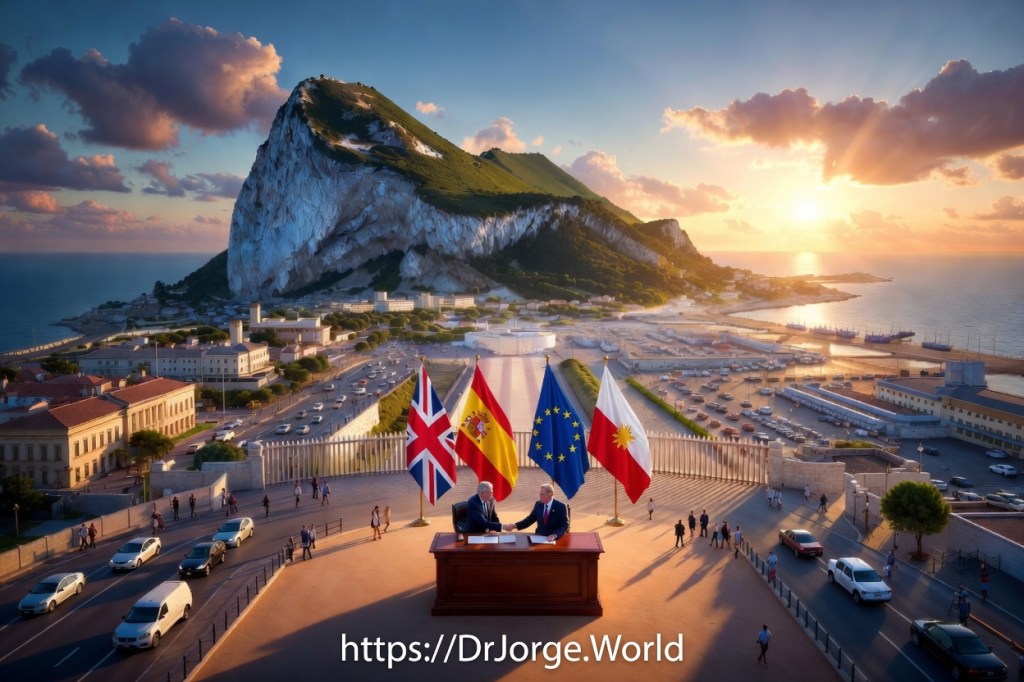
The UK-Spain Agreement on Gibraltar (July 2026): A Multidimensional Analysis
By Jorge Emilio Núñez
The July 2026 UK-EU agreement on Gibraltar, provisionally applied from 15 July 2026, marks a significant development in the long-standing territorial dispute. The treaty removes the physical border fence between Gibraltar and Spain, establishes fluid movement for people and goods, and grants Spain responsibility for Schengen controls at Gibraltar’s airport and port, while explicitly safeguarding British sovereignty and UK military operations. Signed in Brussels on 14 July 2026 by UK Minister Stephen Doughty, EU Commissioner Maroš Šefčovič, Spanish Foreign Minister José Manuel Albares, and Gibraltar Chief Minister Fabian Picardo, the agreement ends years of post-Brexit uncertainty.
My trilogy provides the analytical framework for this review. Sovereignty Conflicts and International Law and Relations: A Distributive Justice Issue (2017) views territorial disputes as distributive justice dilemmas. Territorial Disputes and State Sovereignty: International Law and Politics (2020) examines them through normative, factual, and axiological realms. Cosmopolitanism, State Sovereignty and International Law and Politics: A Theory (2023, Chapter 6) introduces “pluralism of pluralisms,” integrating agents, roles, contexts, realms, and modes of existence (metaphysical, ideal, natural, cultural) across my multidimensional approach that includes linear and nonlinear dimensions, influenced by time and space. This agreement is a practical example of limited, shared sovereignty in action.
Agents and Their Roles
The agreement reflects a pluralism of pluralisms. States are central agents. The United Kingdom, through the Government of Gibraltar and UK representatives, acts as the sovereign guarantor, protecting British sovereignty and military facilities while conceding practical border arrangements. Spain plays the role of Schengen gatekeeper and neighbor, gaining influence over movement without formal sovereignty gains. The European Union serves as the institutional mediator and rule-setter, integrating Gibraltar into Schengen and customs arrangements without full EU membership.
Communities are key agents. The 32,000 Gibraltarians, with their distinct Gibraltarian identity, are the primary beneficiaries of fluid movement, ending decades of border delays for 15,000 daily Spanish cross-border workers. Spanish residents in La Línea and the Campo de Gibraltar gain economic opportunities but lose leverage from previous border controls. Individuals, from daily commuters to military personnel at the UK base, experience direct impacts on daily life.
Roles are pragmatic rather than zero-sum. The UK concedes practical control at the land frontier but retains ultimate sovereignty. Spain gains functional influence while accepting the status quo on sovereignty. The EU facilitates integration. This reflects my 2023 framework: agents play multiple roles in different contexts, moving from absolute to limited sovereignty. The agreement demonstrates how states can cooperate without sacrificing core sovereignty, a point I emphasized in Territorial Disputes (2020) when discussing cases like Gibraltar as examples of divided societies seeking practical coexistence.
The involvement of non-state agents further enriches the pluralism. Local businesses in Gibraltar and La Línea act as economic stakeholders, pushing for the removal of barriers that hindered trade. Civil society groups on both sides of the border advocated for the deal, highlighting human mobility and family ties. Diaspora communities, including Gibraltarians in the UK and Spanish workers with family links, influenced negotiations through lobbying. These agents operate in nonlinear dimensions, where grassroots pressure and economic incentives drove the agreement forward despite historical sovereignty claims. Cosmopolitanism (2023) highlights how such plural agents can create shared arrangements that transcend traditional state-centric models.
Contexts: Domestic, Regional, and International
Domestic Context
Domestically, the agreement is broadly welcomed in Gibraltar as economic security. Chief Minister Fabian Picardo described it as protecting sovereignty while securing the future for businesses and residents. The removal of the border fence ends a physical symbol of division that has stood since 1908. However, concerns remain about Schengen controls at the airport and port potentially creating new bottlenecks. In Spain, the deal is seen as a pragmatic success for the Andalusian region, particularly La Línea, which has suffered economically from previous border restrictions. Domestically in the UK, the agreement is presented as a post-Brexit win that protects sovereignty, though some Brexit hardliners criticize it as a concession. In Territorial Disputes (2020), I noted that domestic political prestige often sustains disputes; here, leaders on all sides can claim victory, reducing the incentive for further escalation.
The domestic context also reveals sociological components. Gibraltarian identity, shaped by centuries of British rule mixed with Spanish cultural influences, has been strengthened by the practical benefits of the deal. Spanish workers crossing daily gain stability, while local businesses benefit from reduced friction. However, the agreement does not resolve underlying identity questions. Some Gibraltarians worry about increased Spanish influence through Schengen controls, while others see it as a pragmatic step toward greater autonomy. Sovereignty Conflicts (2017) would view this as a distributive justice compromise, where practical gains are balanced against symbolic sovereignty concerns. The deal demonstrates how domestic actors can find common ground when economic and human mobility benefits outweigh historical grievances.
Regional Context
Regionally, the agreement strengthens EU-UK cooperation in a sensitive area. Spain gains practical influence over movement while respecting British sovereignty, easing tensions in the Campo de Gibraltar. It sets a precedent for post-Brexit arrangements, potentially influencing other UK-EU border issues. The deal also has implications for NATO, as Gibraltar remains a key strategic base. My 2020 work highlights how regional organizations like the EU can facilitate practical solutions even when sovereignty remains contested.
The regional dimension extends to broader Mediterranean dynamics. The agreement reduces friction at a strategic chokepoint near the Strait of Gibraltar, benefiting trade and security in the Western Mediterranean. It also has implications for Spain’s relations with other EU members, demonstrating that bilateral issues with the UK can be resolved pragmatically. However, it does not eliminate underlying tensions. Spain’s historical claim to Gibraltar remains, and future governments could revisit the issue if domestic political incentives change. Cosmopolitanism (2023) sees this as an example of limited sovereignty in a regional context, where practical integration coexists with unresolved claims. The deal shows how regional interdependence can drive cooperation even in historically contested areas.
International Context
Internationally, the agreement is a rare post-Brexit success for the UK and EU. It demonstrates that pragmatic cooperation is possible despite Brexit. However, it does not resolve Spain’s underlying sovereignty claim, which dates back to the 1713 Treaty of Utrecht. The deal reinforces the principle that practical arrangements can coexist with unresolved sovereignty disputes. From a Cosmopolitanism (2023) perspective, it is an example of limited, shared sovereignty in practice—practical integration without formal transfer of sovereignty.
The international dimension also involves global strategic considerations. Gibraltar’s location at the entrance to the Mediterranean makes it strategically important for trade routes and military projection. The agreement ensures continued UK military operations while integrating Gibraltar into Schengen for civilian movement. This balance has been welcomed by NATO allies, who see it as stabilizing a key base. However, it also highlights the limitations of traditional sovereignty models in a globalized world. Territorial Disputes (2020) notes that international agents often have interests beyond the immediate claimants, and this agreement shows how those interests can drive pragmatic solutions. The involvement of the EU as a mediator demonstrates how supranational organizations can facilitate arrangements that bilateral talks alone might not achieve.
Realms: Normative, Factual, and Axiological
Normative Realm
Normatively, the agreement is grounded in public international law. It respects the principle of consent and avoids violating the Treaty of Utrecht’s sovereignty provisions. It aligns with the EU-UK Trade and Cooperation Agreement while creating a tailored regime for Gibraltar. The deal upholds self-determination for Gibraltarians, who overwhelmingly support remaining British. However, it does not resolve Spain’s historical claim, leaving the normative sovereignty question open. Sovereignty Conflicts (2017) would see this as a pragmatic distributive compromise rather than a final justice-based resolution.
The normative dimension also involves human rights and mobility rights. The removal of the border fence enhances freedom of movement, aligning with European human rights standards. However, the introduction of Schengen controls at the airport and port raises questions about proportionality and non-discrimination. The agreement attempts to balance these concerns through tailored arrangements, but critics argue it creates a two-tier system for travelers. My 2017 work emphasizes that distributive justice requires fair procedures, and the agreement’s success will depend on how equitably these controls are implemented in practice.
Factual Realm
Factually, the agreement delivers tangible benefits: removal of the physical border fence, fluid movement for people and goods, and Schengen controls at the airport and port. This ends daily delays for thousands of workers and improves economic prospects for Gibraltar and the surrounding Spanish region. The UK retains full control over its military base, a key factual red line. The deal creates a new reality on the ground: a fluid frontier with practical EU integration while maintaining British sovereignty. Territorial Disputes (2020) emphasizes that factual arrangements often matter more than abstract legal titles in daily life.
The factual impact extends to economic and social realities. Cross-border workers, previously facing long delays, now benefit from smoother commutes, potentially boosting productivity in both Gibraltar and La Línea. Tourism and trade are expected to increase significantly. However, the agreement also creates new factual challenges, such as managing increased traffic at the airport and port under Schengen rules. These practical issues will test the agreement’s implementation in the coming months. The factual realm, as I analyze in my 2020 book, is where the success or failure of such arrangements is ultimately determined.
Axiological Realm
Axiologically, the agreement balances competing values. It respects Gibraltarian identity and self-determination while acknowledging Spanish historical and geographical interests. It values economic pragmatism and human mobility over strict territorial exclusivity. However, underlying value clashes remain: Spanish national pride in recovering influence versus British commitment to Gibraltar’s wishes. Cosmopolitanism (2023) sees this as a partial reconciliation of plural values through practical shared arrangements.
The axiological dimension also involves questions of fairness and justice. Gibraltarians value their British identity and autonomy, while many Spaniards see the agreement as a step toward historical rectification. The deal attempts to reconcile these values by prioritizing practical coexistence. However, if implementation favors one side disproportionately, it could reignite axiological tensions. My trilogy consistently argues that sustainable solutions must address values and identities, not just legal titles or factual control.
Modes of Existence: Metaphysical, Ideal, Natural, and Cultural
Metaphysical Mode
Metaphysically, Gibraltar carries symbolic weight for both sides—British imperial legacy versus Spanish historical reclamation. The agreement largely sidesteps these eternalist claims, focusing on practical coexistence rather than resolving underlying narratives. This pragmatic approach reflects the limitations of metaphysical claims in modern territorial disputes. Cosmopolitanism (2023) suggests that metaphysical modes can be accommodated through shared arrangements rather than absolute resolution.
The metaphysical dimension remains potent. For some Spaniards, Gibraltar symbolizes unfinished historical business from the Treaty of Utrecht. For Gibraltarians, it represents a distinct identity forged over centuries. The agreement does not erase these metaphysical attachments but channels them into practical cooperation. This is consistent with my 2023 framework, which advocates managing rather than eliminating metaphysical tensions in pluralistic settings.
Ideal Mode
Ideally, the deal represents a compromise between absolute sovereignty and practical integration. It moves toward the ideal of limited, shared sovereignty I advocate in Cosmopolitanism (2023), where states cooperate without full transfer of authority. The agreement approximates an ideal balance between British sovereignty and European integration for Gibraltar. However, it falls short of a final resolution of Spain’s claim, leaving room for future ideal-type debates about self-determination and historical justice.
The ideal mode also involves questions of fairness and consent. The agreement was negotiated with Gibraltarian input, respecting self-determination principles. This aligns with the ideal of inclusive decision-making I discuss in my 2017 work. Yet, the underlying sovereignty dispute remains unresolved, meaning the agreement is an ideal compromise rather than an ideal solution.
Natural Mode
Naturally, the agreement addresses resource and mobility realities. The fluid border improves access to jobs, services, and economic opportunities for people on both sides, reflecting the natural interdependence of the region. Gibraltar’s economy, heavily reliant on cross-border labor and tourism, benefits from reduced friction. The surrounding Spanish region gains from easier access to Gibraltar’s services and markets. Territorial Disputes (2020) emphasizes that natural modes—resources, geography, daily movement—often drive practical solutions even when metaphysical or ideal claims remain contested.
The natural dimension also includes environmental considerations. The agreement facilitates better management of shared marine resources around Gibraltar, potentially improving cooperation on conservation and fisheries. This practical focus on natural realities demonstrates how territorial disputes can be managed through functional cooperation, as I advocate in my trilogy.
Cultural Mode
Culturally, the agreement acknowledges Gibraltarian distinctiveness while facilitating cross-border cultural and economic ties. It reduces daily friction that previously reinforced division. The removal of the physical fence symbolizes a cultural shift toward coexistence. However, cultural identities remain strong on both sides, and the agreement does not erase historical narratives. Territorial Disputes (2020) analyzes cultural modes as axiological amplifiers, where identities like Gibraltarian Britishness versus Spanish historical claims create mutual exclusion, perpetuating the status quo unless actively managed.
The cultural dimension will be tested in implementation. Daily interactions between Gibraltarians and Spanish workers may foster greater understanding, but they could also highlight differences if economic benefits are uneven. The agreement’s success will depend on whether it can foster a shared cultural space while respecting distinct identities.
Public International Law and Geopolitics
The agreement is a creative application of public international law. It respects the Treaty of Utrecht’s sovereignty clause while creating a tailored post-Brexit regime. It aligns with self-determination principles and EU law on external borders. Geopolitically, it strengthens EU-UK cooperation in a strategically important location near the Strait of Gibraltar, a key chokepoint for global trade. It reduces friction that could have been exploited by third parties and sets a positive precedent for post-Brexit relations.
The geopolitical dimension extends beyond Europe. The agreement stabilizes a key NATO base, benefiting collective defense. It also demonstrates that pragmatic solutions can be found even in long-standing disputes, potentially influencing other territorial conflicts. However, it does not eliminate Spain’s underlying claim, meaning geopolitical tensions could resurface if broader UK-EU relations deteriorate. My 2020 work notes that geopolitical interests often sustain territorial disputes even when practical arrangements are in place.
Leaders’ Prestige and Roles
Leaders have used the issue for domestic prestige. UK governments have long defended Gibraltar to signal resolve on sovereignty. Spanish governments have used the claim to appeal to national sentiment. The 2026 agreement allows both sides to claim success: the UK protects sovereignty, Spain gains practical influence, and Gibraltar secures its economic future. This mutual face-saving is a classic example of how leaders’ prestige can facilitate rather than block pragmatic solutions when aligned with practical benefits.
The role of leaders in this agreement demonstrates the importance of prestige in territorial disputes, as I analyzed in Territorial Disputes (2020). Fabian Picardo’s leadership in Gibraltar ensured local interests were protected, enhancing his domestic standing. Spanish and UK leaders balanced national pride with pragmatic outcomes. This shows that when leaders can claim victory on multiple fronts, resolution becomes more feasible.
International Organizations: Biases, Successes, and Failures
The EU played a constructive mediating role, facilitating a tailored arrangement that balances its border rules with political realities. This is a success for pragmatic diplomacy. The UN has remained largely sidelined, as the issue has been handled bilaterally/multilaterally between the UK, Spain, Gibraltar, and the EU. NATO benefits indirectly from reduced friction at a strategic base. The agreement demonstrates that organizations can succeed when they facilitate practical shared arrangements rather than insisting on absolute solutions.
The success of the EU in this case contrasts with its struggles in other disputes. It shows that when organizations focus on practical integration rather than sovereignty resolution, they can deliver results. However, the agreement also reveals biases: the EU prioritized its border rules, while the UK prioritized military autonomy. Cosmopolitanism (2023) suggests that organizations should evolve toward more pluralistic models to address such biases.
Evaluation and Multidimensional Solutions
The 2026 Gibraltar agreement is a rare positive example of limited, shared sovereignty in practice. It moves beyond zero-sum thinking by creating practical integration while protecting core sovereignty concerns. It aligns with the multidimensional approach I advocate: acknowledging plural agents (Gibraltarians, Spanish workers, UK military), multiple contexts, and different realms. It shows that pragmatic, limited sovereignty can deliver better outcomes than rigid absolutism.
However, it is not a final resolution. Spain’s underlying claim remains, and future tensions could arise if economic benefits are uneven or if geopolitical shifts occur. The agreement succeeds because it focused on factual daily realities rather than metaphysical or ideal absolutes. My trilogy consistently argues that sustainable solutions must address all dimensions, not just practical ones.
Multidimensional solutions for similar disputes would build on this model. Shared sovereignty arrangements, nonlinear mediation involving all agents, and time-space adaptive mechanisms (e.g., climate and economic reviews) could be applied elsewhere. The Gibraltar case demonstrates that progress is possible when parties prioritize practical coexistence over absolute victory.
Conclusion
The UK-Spain agreement on Gibraltar, provisionally applied from 15 July 2026, represents a pragmatic milestone in a dispute that has persisted for over three centuries. By removing the physical border fence, establishing fluid movement for people and goods, and creating tailored Schengen controls at the airport and port while explicitly safeguarding British sovereignty and military operations, the deal demonstrates that limited, shared sovereignty can deliver tangible benefits. It aligns with the multidimensional approach I advocate in Cosmopolitanism (2023), where agents play multiple roles across contexts and realms, moving beyond absolute claims toward practical coexistence. The agreement succeeds because it focuses on factual daily realities—economic mobility, cross-border work, and regional stability—rather than attempting to resolve the underlying metaphysical and historical sovereignty claims. In doing so, it provides a model for other territorial disputes where zero-sum thinking has led to prolonged stalemates.
Inportantly, the agreement is not a final resolution. Spain’s historical claim, rooted in the 1713 Treaty of Utrecht, remains formally intact, and future political shifts in Madrid or London could reopen the issue. The success of the deal will depend on equitable implementation: whether Schengen controls at the airport and port create new bottlenecks, whether economic benefits are shared fairly between Gibraltar and the Campo de Gibraltar, and whether local identities are respected amid increased integration. Territorial Disputes (2020) warns that factual arrangements, while important, can mask deeper axiological tensions if they do not address cultural and identity concerns. The agreement’s longevity will be tested by how well it balances these elements, particularly as climate change and resource pressures in the Mediterranean intensify.
Ultimately, the Gibraltar case illustrates both the potential and the limitations of the current world order. It shows that creative diplomacy and supranational facilitation (through the EU) can produce workable compromises, but it also highlights the persistence of distributive justice gaps identified in Sovereignty Conflicts (2017). True lasting peace in such disputes requires moving toward the pluralistic, shared sovereignty model I propose in Cosmopolitanism (2023)—one that fully integrates local voices, addresses all realms (normative, factual, axiological), and accommodates multiple modes of existence. Gibraltar offers hope that such an evolution is possible, but sustained commitment from all agents will be necessary to ensure the agreement becomes a foundation for genuine reconciliation rather than a temporary pause in an unresolved conflict.
AUTHOR’S SAMPLE PEER-REVIEWED ACADEMIC RESEARCH (FREE OPEN ACCESS):
State Sovereignty: Concept and Conceptions (OPEN ACCESS) (IJSL 2024)
AUTHOR’S PUBLISHED WORK AVAILABLE TO PURCHASE VIA:
Thursday 23rd July 2026
Dr Jorge Emilio Núñez
X (formerly, Twitter): https://x.com/DrJorge_World

