
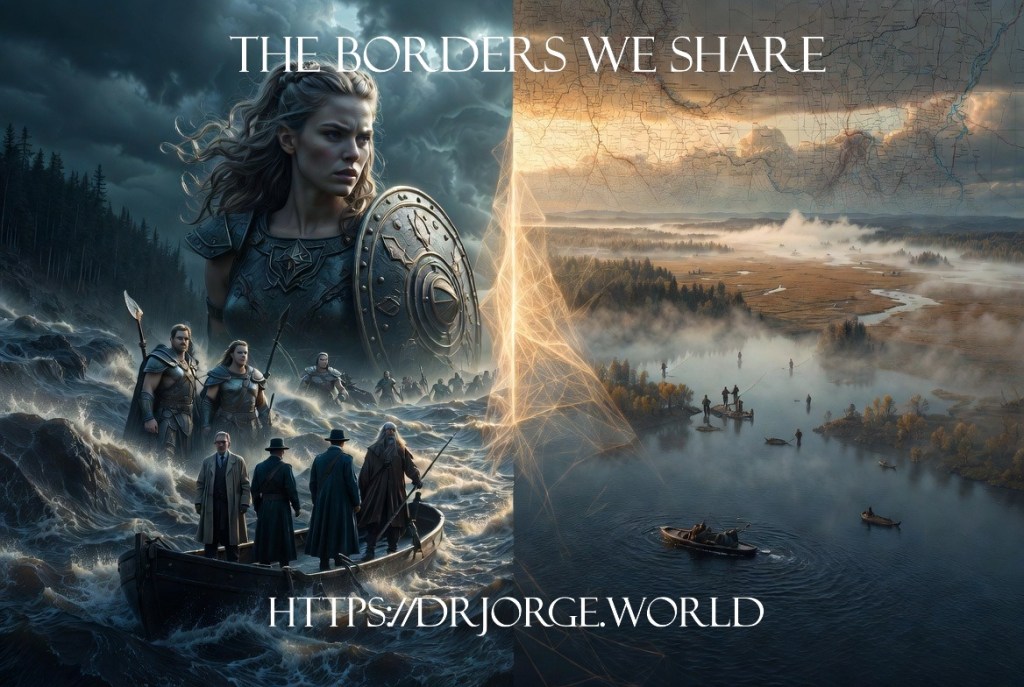
The Borders We Share: A New Way to Fix a Broken World
Section 8: Rivers and Flows (Posts 43–48)
Post 48: Cimmeria’s Flood, Amur’s Edge: Dust Washes East
Echoes from the Roaring Waters
Where rivers rage like untamed beasts, carving canyons through time and carrying the powdered remains of empires toward sunrise seas, Cimmeria’s savage floods clash with the Amur’s brooding frontier edge. These waters do not whisper—they thunder. Here, Dr. Jorge, the series’ guiding sage, gathers once more with Sherlock Holmes, whose mind cuts sharper than any blade, Dr. John Watson, ever faithful recorder of truth, and King Arthur, whose legacy reminds us that leadership is measured by service, not dominion. They stand shoulder to shoulder with shades of Cimmerian legends—Conan’s fierce ancestors, born of storm and iron—and the custodians of the Amur: Tungusic shamans, Cossack explorers, and today’s stewards balancing the vast interests of Russia, China, and Mongolia.
In The Borders We Share, Section 8 reaches its crescendo. We no longer treat rivers as lines to be claimed, but as living forces that mock our divisions. They flood across borders, deposit fertile chaos, and wash ancient dust eastward in a slow, unstoppable promise of renewal. Leaving behind Narnia’s enchanted streams and the Euphrates’ weary cradle, we now confront Cimmeria’s primal deluges and the Amur’s immense, mist-veiled boundary. Here, myth and geopolitics collide in raw power. Every cresting wave and settling silt particle invites us to imagine sovereignty not as possession, but as participation in something far greater.
This series has walked us across deserts of oil, frozen summits, whispering forests, parched plains, and fractured cities. Water now delivers its final lesson in this section: unrelenting, connective, and utterly indifferent to human pride. Cimmeria evokes a savage, storm-lashed world where strength is forged in hardship. The Amur, stretching over 4,400 kilometres, ranks among the planet’s mightiest free-flowing rivers. Rising from Mongolian highlands, it forms a natural divide between Russia and China, sustaining tigers, sturgeon, cranes, and millions of frontier lives before surrendering to the northern Pacific.
Forged in Surge and Shadow
Cimmeria is a place of dark forests, iron-grey skies, and rivers with violent tempers. When rains and snowmelt conspire, these waters burst free, reshaping valleys, swallowing settlements, and redistributing soil in a violent act of both destruction and creation. For hardy clans, floods are annual trials—destroyers of the weak, sculptors of the resilient. Neglect or upstream arrogance turns blessing into catastrophe: villages swept away, livelihoods erased, and the delicate pact between people and wilderness broken.
The Amur tells a grander, slower story. Its basin spans taiga, steppe, and floodplain, nurturing one of Asia’s last great wilderness corridors. Iconic species like the Amur leopard and massive kaluga sturgeon still glide through its depths, while border communities fish, farm, and trade along its banks. Yet the river bears heavy scars: industrial effluents from the Songhua River, upstream deforestation, wetland shrinkage, and floods growing fiercer with climate disruption. While Russia and China have resolved many territorial disputes through diplomacy, water quality, ecological decline, and differing visions of development remain flashpoints. Mongolian headwaters add a third voice to this complex symphony.
The human toll is immense—fisheries collapsing, health impacts from pollution, and flood damages measured in hundreds of millions. In Cimmeria’s floods we see nature’s unforgiving forge; along the Amur’s edge we witness two global powers and ancient cultures learning, sometimes painfully, that no single hand can tame a river this vast.
Webs of Storm, Silt, and Spirit
Rivers are master storytellers. In Cimmeria, floods birth legends. Around hearth-fires, survivors recount nights when the waters rose and only courage and clan bonds kept them alive. Conan-like heroes emerge not from conquest but from standing firm when everything else is swept away. Strength here is honest, elemental, and communal.
On the Amur, the tapestry grows richer and more layered. Indigenous Nanai, Evenki, and Ulchi peoples read the river like a living scroll—its moods, colours, and gifts woven into shamanic ritual and practical survival. Russian frontier tales speak of Cossack fortitude and Soviet-era transformation. Chinese narratives celebrate modernisation and the feeding of millions. Yet all these threads fray where pollution silences fish runs and habitat loss dims the glow of fireflies over wetlands. The river dragon of local lore grows restless, demanding respect.
My long-developed ideas in Sovereignty Conflicts (2017) and Territorial Disputes (2020) illuminate the familiar triangle: states asserting power, the river and its dependent lives as the true contested heart, and the human and ecological price of exclusion. Cosmopolitanism and State Sovereignty (2023) points toward a richer path—multidimensional pluralism that weaves together state authority, scientific insight, indigenous wisdom, and local stewardship. Scattered bilateral agreements and protected areas along the Amur offer hope. The challenge is to deepen them into something transformative.
Hymn of Silt and Renewal
When fear divides, floods become disasters. When imagination unites, the same waters deliver life. In Cimmeria, a covenant rises from the mud of the latest great inundation. Clans, together with former outsiders, establish shared watch systems, reforest upstream slopes, and design settlements that dance with the river rather than fight it. Flood-borne sediment becomes building material for renewed prosperity; displaced families return to stronger homes and restored fisheries.
Along the Amur, a bolder trilateral spirit takes hold. Joint teams track pollution in real time, revive degraded wetlands, and coordinate flood releases that protect rather than punish. Sustainable fishing zones, eco-tourism, and careful green energy projects generate funds that flow back into communities and conservation—protecting tigers, restoring sturgeon runs, and honouring traditional ways of life. The dust that once symbolised loss now nourishes fresh growth as it travels east.
This is egalitarian shared sovereignty in action: equal seats at the table for nations and communities; roles that value both ancient knowledge and modern science; benefits tied directly to the river’s measurable vitality; and stronger partners lifting those with fewer resources. Adaptive zones and transparent data turn suspicion into alliance.
Voices Carried on the Flood
A heavy barge, reinforced against ice and surge, rides the turbulent meeting point where Cimmeria’s wild waters pour into the Amur’s broad, silt-rich flow. Taiga looms on one side, distant Mongolian hills fade on the other. Lanterns sway as the Council assembles.
A Cimmerian shield-maiden, scars visible on her arms, plants her boots wide against the deck’s roll. “I have watched rivers swallow whole villages,” she growls. “They care nothing for borders or banners. We bled alone for generations. The flood taught me this: stand together or be swept away.”
An elder from a Nanai village speaks next, voice steady as slow water: “Our ancestors spoke with the river spirit. Now the water runs heavy with poison from distant factories. The sturgeon weaken. Our children ask why the songs grow quiet. We bring knowledge of every bend and season. Will you listen?”
A Chinese basin manager responds with measured candour: “Upstream growth brought light and food to millions, yet we see the downstream shadow lengthen. Joint monitoring stations and shared forecasting are no longer optional—they are survival.”
A Russian regional leader nods: “Our shared border has known peace on land. The river now asks us to make that peace deeper, wetter, and wiser. Indigenous voices and open data must be at the centre.”
Sherlock Holmes leans forward, eyes gleaming. “The pattern is unmistakable. Unilateral decisions produce cascading, measurable harm—fishery collapse, biodiversity loss, rising flood costs. Only a pluralistic authority with clear ecological red lines can satisfy logic and justice alike.”
Dr. Jorge offers synthesis: “True shared sovereignty demands structure—equal participation, complementary roles, outcomes linked to the river’s health, and deliberate support across differences of power.”
King Arthur’s voice carries the weight of centuries: “I never ruled by claiming every drop of water in my realm, but by ensuring every soul could drink and thrive beside it. Rivers are the realm’s blood. Hoard them and the body fails.”
The Cimmerian warrior smiles fiercely. “Then let the floods wash the old hatreds east. We stand together.” Hours of frank exchange—on funding, enforcement, cultural rights, and climate realities—yield a living agreement: a basin authority with real authority, local vetoes on existential threats, revenue sharing for restoration, protected ecological corridors, and pathways for traditional fishers to cross borders freely. As the barge steadies, the currents themselves seem to approve.
Why does this matter to you?
Rivers like Cimmeria’s floods and the Amur’s edge show us that nature’s greatest forces become destructive only when we refuse to work with them. The dust they carry eastward can bury the past or seed the future. In a world facing fiercer storms, shifting powers, and strained resources, how we govern these mighty shared waters will shape the fate of iconic species, frontier economies, and regional peace.
This matters to you because water respects no passport. The Amur’s health influences global biodiversity, climate systems, and supply chains that reach every continent. Your voice, your vote, your consumption patterns—all send ripples. Will we let old divisions amplify coming floods, or build models of cooperation that turn silt into shared foundation?
Section 8 ends, but the journey of The Borders We Share flows on. What will the next current reveal—and what role will you play in directing it?
Trails to Wander:
• Sovereignty Conflicts (2017).
• Territorial Disputes (2020).
• Cosmopolitanism and State Sovereignty (2023).
• Territorial Disputes in the Americas (2025).
NOTE:
New posts every Tuesday. Next post Tuesday 1st September 2026.
PREVIOUS POSTS:
Post 47: Narnia’s Run, Euphrates’ End: Royal Rivers
NEXT POSTS:
Section 8 Recap: Rivers and Flows (Posts 43–48)
AUTHOR’S SAMPLE PEER-REVIEWED ACADEMIC RESEARCH (FREE OPEN ACCESS):
State Sovereignty: Concept and Conceptions (OPEN ACCESS) (IJSL 2024)
AUTHOR’S PUBLISHED WORK AVAILABLE TO PURCHASE VIA:
Tuesday 23rd June 2026
Dr Jorge Emilio Núñez
X (formerly, Twitter): https://x.com/DrJorge_World

