
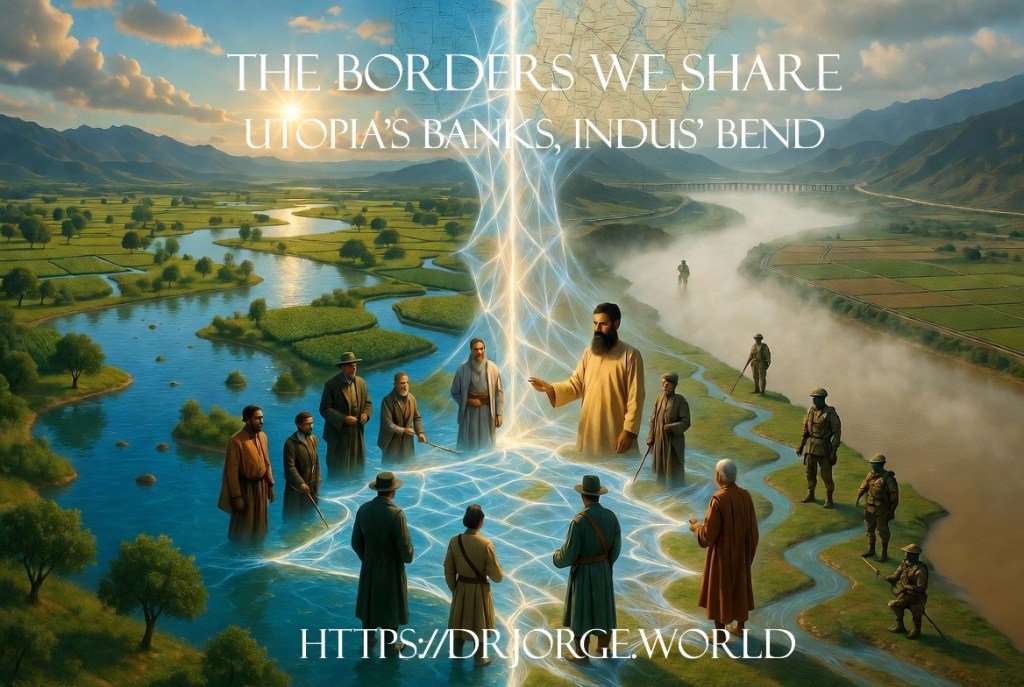
The Borders We Share: A New Way to Fix a Broken World
Section 8: Rivers and Flows (Posts 43–48)
Post 45: Utopia’s Banks, Indus’ Bend: Perfect Waters
The water flows clear and steady, carrying the dreams of two worlds.
One is Utopia’s Banks, the orderly rivers that wind through Thomas More’s perfect island society — channels of reason where every stream serves the common good, every bank is shared, and no private greed diverts the flow. The other is the Indus River, the ancient lifeblood of the Indian subcontinent, rising in the snows of the Himalayas and carving its way through India and Pakistan — a river that has nourished civilizations for five thousand years, yet today is strained by upstream dams, downstream needs, and the enduring scars of Partition.
I arrive with the companions who have crossed every fractured frontier of this series: Sherlock Holmes, deerstalker traded for a wide-brimmed hat against the sun on the water; Dr. John Watson, notebook curling at the edges from the humidity; King Arthur, who has swapped mail for a plain traveller’s cloak but still carries Excalibur at his side like a vow that no river can be owned by one alone.
With us walk the people who belong to these waters.
From Utopia’s Banks come Governor Ademus, elected for wisdom yet bound by the island’s rigid laws; a young Utopian farmer whose fields depend on the river’s steady flow; a former bondman now freed who tends the communal banks; and a dissident scholar who questions whether perfection can ever truly share its waters.
From the Indus come a Pakistani farmer from Sindh whose fields wither when upstream flows are restricted; an Indian engineer from the upper reaches who defends his nation’s right to develop its own resources; a Sindhi activist fighting for downstream rights; and a Kashmiri elder who remembers when the river flowed freely across a once-united land.
This is Post 45, the third stride in Section 8: Rivers and Flows. We have left Laputa’s falls and the Mekong. Now the series follows water through ideals and realities, where sovereignty is measured not in cubic metres alone but in the trust between upstream and downstream, and the question of whether a perfect system can ever truly share its flow.
Utopia’s Banks – The Perfect Current
Utopia’s Banks are the clear, orderly rivers that wind through Thomas More’s perfect island society. Every stream serves the common good, every bank is shared, and no private greed diverts the flow. The water is managed with mathematical precision — canals, locks, and communal irrigation ensure fairness. The river is a model of reason: steady, predictable, and allocated according to need. The banks are lined with neat orchards and communal fields where citizens work in rotation, their labour contributing to the collective bounty. Yet beneath the surface lies a quiet tension. The island’s rigid laws leave little room for the unexpected. When droughts come or upstream needs change, the perfect system struggles to adapt. The farmers and former bondmen who tend the banks have no real voice in the decisions made in the Senate. They live by the river’s grace, yet the grace feels increasingly conditional, as though perfection itself has become a cage that limits the very flow it claims to protect.
The water in Utopia is meant to be eternal and equitable, yet the rigid schedules sometimes leave lower fields parched while upper canals overflow. The dissident scholar walks the banks at dusk, wondering aloud whether a system that eliminates all private desire can ever truly understand the living needs of those who depend on the current. The former bondman, hands still calloused from years of service, tends the communal sluices and whispers that even perfect laws can leave some thirsty if they forget the human hands that guide the water.
The Indus – The Contested Current
The Indus is brutally real. It rises in the snows of the Himalayas and flows through India and Pakistan, sustaining over 200 million people. Since Partition in 1947, the river has been governed by the 1960 Indus Waters Treaty, which allocates the eastern rivers to India and the western rivers primarily to Pakistan. Yet upstream dams in India, climate change, and population growth have strained the agreement. Downstream Pakistan faces reduced flows, salinity intrusion in the Delta, and declining agricultural yields. Both nations claim historical and legal rights; both accuse the other of violating the spirit of the treaty. The river that once united the land now divides it, its waters carrying both life and the memory of division.
The Pakistani farmer from Sindh stands on cracked fields and watches the river arrive thinner each season. The Indian engineer measures releases from upstream dams with pride in national development, yet knows the tension it creates downstream. The Sindhi activist documents the human cost — villages where women walk kilometres for water, children whose futures shrink with every dry season. The Kashmiri elder remembers a time when the river flowed freely across a land not yet split by borders. The Indus does not forget. It carries the weight of history in every drop, the memory of unity and the pain of separation.
The Mirror They Hold Up
Sovereignty Conflicts frames both as classic triadic disputes: two privileged claimants exercising sovereignty over a populated third territory whose constitutive population is treated as peripheral to the claim yet suffers the direct environmental and economic cost.
Territorial Disputes adds the sociological fracture: in Utopia the Senate’s perfect order versus the lived needs of those by the banks; on the Indus upstream development versus downstream survival.
Cosmopolitanism and State Sovereignty asks the moral question: can a claim to water be legitimate if it systematically deprives those downstream who have depended on it for generations?
Territorial Disputes in the Americas provides the practical precedent: guarantor-led shared-resource zones that have achieved high durability in Latin American cases — models now urgently needed here for a river that knows no single owner.
The Evidence Gathered in Flow and Memory
Holmes refuses to stay on the bank. He spends four days walking Utopia’s Banks with the farmers and former bondmen, measuring flow rates, noting seasonal changes, and timing the rigid schedules of the Senate’s irrigation decrees. He spends the next four days travelling the Indus with engineers, farmers, and activists, timing dam releases and the arrival of reduced flows in Sindh. The data he returns with are starkly symmetrical.
In Utopia’s Banks, dry-season flow has dropped by 21 % due to rigid upstream management; 1,300 farming families face uncertainty and failing crops. On the Indus, downstream flow has decreased by 18–24 % during critical periods; millions in Pakistan face declining yields, drinking water shortages, and increasing salinity. In Utopia, zero Senators have consulted the riverside communities about the banks’ health. On the Indus, high-level negotiations rarely include the farmers most affected by the decisions made far upstream.
Watson’s notebook grows heavy: “Both waters are being managed by powers that rarely stand in the current. The difference is only in the signature — perfect decree or treaty clause.”
Arthur stands on Utopia’s Banks watching the orderly flow, then stands on the Indus bank watching a distant dam release. He says only: “A river does not care who claims it. It only remembers who cared for its banks and who let it run free.”
A Conclave by the Water
We meet where the two waters almost touch: a neutral bank on Utopia’s lowest terrace, lowered to within 100 metres of the Indus for the first time in history, with representatives from both nations brought by boat and helicopter
.Present: Governor Ademus, seated on a simple bench of polished stone, visibly uncomfortable at being so close to untamed water; the young Utopian farmer; the former bondman; the Pakistani farmer from Sindh; the Indian engineer; the Sindhi activist; Hamed al-Ghabri, the Omani elder whose water-bag has become a symbol of cross-border memory.
The young Utopian farmer speaks first: “The water is flowing. It does not ask permission. It only asks to be shared.”
The Pakistani farmer answers, voice heavy with exhaustion: “Our fields are cracking under the sun. The river that once fed us now arrives late and thin. We ask only for the right to the steady flow our ancestors knew, the flow that once made the desert bloom.”
The Indian engineer, voice measured but firm: “Development is our right. The dams bring electricity to millions and control floods that once destroyed lives. Downstream nations must understand that progress upstream benefits the whole basin.”
Arthur lays Excalibur flat across a smooth stone by the water’s edge. Every hand — governor, farmer, engineer, activist — rests on the scabbard at once.
I open Sovereignty Conflicts:
“Egalitarian shared sovereignty does not ask who owns the water. It asks how we keep the river from running dry beneath the dams and claims that divide us.”The Sindhi activist, voice rising with passion: “The Indus is our mother. When she weakens, our children hunger and our villages turn to dust. Upstream dams cannot ignore downstream life. We have waited long enough for fairness.”
The former bondman, voice steady and grounded: “In Utopia we learned that perfect laws can still leave some thirsty. The river does not care for perfection written on paper. It cares for fairness felt in the soil and in the hands that work it.”
Governor Ademus, after a long silence, his face thoughtful: “Our system was built for equality. Yet equality that ignores the needs of those downstream is no equality at all. We must find a way to let the water serve all, not just the vision of the few.”
The Indian engineer, nodding slowly: “If we share the data, the releases, the benefits — perhaps the river can feed us all without starving any. Progress need not come at the cost of our neighbours.”
The young Utopian farmer, eyes bright with hope: “Then let us make a new law of the banks — one where the strong protect the weak, and the river runs for all. No one takes more than they need, and everyone gives back what they can to keep the current strong.”
Arthur’s voice, quiet as a vow yet carrying across the water: “A sword laid flat is not surrender. It is invitation. Let every hand rest here, and let the river judge what is just.”
The “River Accord” is drafted in water and ink:
- Joint Utopia–Indus River Commission with binding flow-release schedules and real-time data sharing; surplus benefits fund cross-border infrastructure and drought resilience.
- Utopia’s Banks and the Indus declared shared ecological corridors; 35 % of any future resource revenue funds permanent descent corridors and community-led water projects.
- “Water-to-Sky Residency Pathway”: ten continuous years of contribution (farming, stewardship) = permanent residency rights or citizenship on grounded rings.
- Higher Court seated alternately in Islamabad/Delhi and on Utopia’s riverbank, with judges from Indian, Pakistani, Utopian, and local communities; veto power on any project that reduces downstream flow below agreed levels.
- Every new dam or crystal operation must display, in Urdu, Hindi, English, and Utopian dialect, the flow data and the names of the communities and workers who sustain the river.
Governor Ademus signs first, his hand steady because it rests near running water. The Pakistani farmer signs second. The Indian engineer signs third. The Sindhi activist signs fourth. The young Utopian farmer signs last — his calloused hand pressing the parchment into the wet bank as seal.
Murmurs of the Living Current
The wind still carries warnings: dams will hold back, rivers will run thin, people will thirst. Yet it also carries new notes: the steady rush of regulated flow reaching downstream fields, the laughter of Indian and Pakistani children learning river stewardship together on a neutral bank, the quiet splash of a Utopian scholar choosing to wade rather than float, the sound of a water-bag being refilled from a stream that no longer runs dry.
Peace along this vertical-and-horizontal frontier is not a treaty signed in glass towers. It is a drop of water left to flow freely so a field may grow, a path reopened so a farmer may tend his crops, a river whose song is wide enough for every engineer and every herder to drink beneath the same sky.
Why This Resonates in You
You have stood by a river and felt its current pull at your feet.
You have watched water flow past a border and wondered why one side drinks while the other thirsts.
You have, perhaps, never met the farmer whose fields dried because a dam held back the flow, the engineer who balanced progress with equity, or the scholar who learned that the stars are beautiful but the water is home.
The Borders We Share asks only one thing: the next time you look at a river, remember there is always a current — and that the current remembers every bank, every promise kept or broken.
Next Tuesday we follow the water further — new tides, new dances.
I remain, as always,
Dr. Jorge
Trails to Wander:
• Sovereignty Conflicts (2017).
• Territorial Disputes (2020).
• Cosmopolitanism and State Sovereignty (2023).
• Territorial Disputes in the Americas (2025).
NOTE:
New posts every Tuesday. Next post will be available on Tuesday 9th June 2026.
PREVIOUS POSTS:
Post 44: Laputa’s Falls, Mekong’s Rush: Sky to Stream
NEXT POSTS:
Section 8: Rivers and Flows (Posts 43–48)
46, Ruritania’s Tide, Danube’s Dance: Crowns of Current
47, Narnia’s Run, Euphrates’ End: Royal Rivers
48, Cimmeria’s Flood, Amur’s Edge: Dust Washes East
AUTHOR’S SAMPLE PEER-REVIEWED ACADEMIC RESEARCH (FREE OPEN ACCESS):
State Sovereignty: Concept and Conceptions (OPEN ACCESS) (IJSL 2024)
AUTHOR’S PUBLISHED WORK AVAILABLE TO PURCHASE VIA:
Tuesday 12th May 2026
Dr Jorge Emilio Núñez
X (formerly, Twitter): https://x.com/DrJorge_World
 Dr Jorge's World
[…] The Borders We Share: Utopia’s Banks, Indus’ Bend (Post 45) […]
LikeLike