
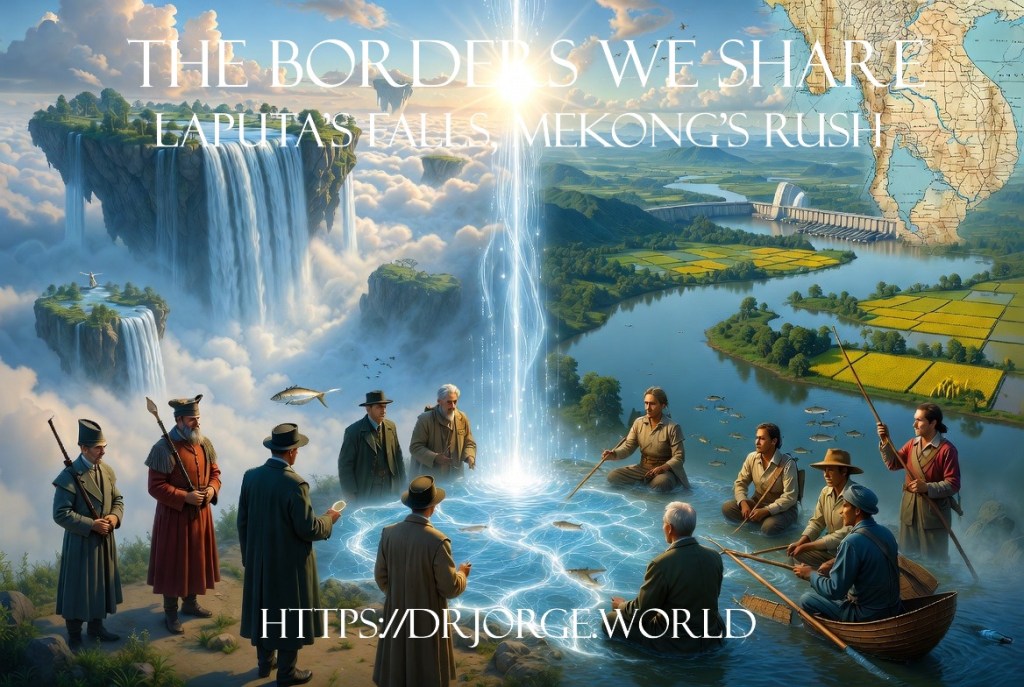
The Borders We Share: A New Way to Fix a Broken World
Section 8: Rivers and Flows (Posts 43–48)
Post 44: Laputa’s Falls, Mekong’s Rush: Sky to Stream
The water falls from two worlds at once.
One is Laputa’s Falls, the cascading streams that pour from the edges of the floating island like silver threads woven from cloud and crystal, tumbling thousands of metres before they dissolve into mist or strike the earth below. The other is the mighty Mekong, the “Mother of Waters,” flowing 4,350 kilometres from the Tibetan Plateau through China, Myanmar, Laos, Thailand, Cambodia, and Vietnam—a lifeline for 60 million people that has nourished rice fields, fisheries, and civilizations for millennia, yet is now reshaped by upstream dams and downstream thirst.
Both waters fall from heights.
Both are contested.
Both carry life and memory in their current.
Both are claimed by powers that rarely stand in the spray.
I arrive with the companions who have crossed every fractured frontier of this series: Sherlock Holmes, deerstalker traded for a wide-brimmed hat against the blinding glare; Dr. John Watson, notebook curling at the edges from the spray; King Arthur, who has swapped mail for a plain traveller’s cloak but still carries Excalibur at his side like a vow that no river can be owned by one alone.
With us walk the people who belong to these waters.
From Laputa’s Falls come the cloud-weavers who tend the crystal reservoirs; the mist-dwellers who live on the island’s lower ledges where the falls begin; a young Laputan engineer who warns that the island’s levitation is destabilizing the flow; and an exiled scholar who says the water has begun to sing in two voices since the magnetic drift intensified.
From the Mekong come a Lao fisherwoman from the Golden Triangle whose nets have grown lighter each season; a Vietnamese rice farmer from the Delta whose fields shrink with saline intrusion; a Cambodian activist fighting upstream dam impacts on Tonlé Sap; and a Chinese engineer from the upper reaches who defends the right of his nation to develop its own resources.This is Post 44, the second stride in Section 8: Rivers and Flows. We have left Sherwood’s stream and the Nile. Now the series follows water as it falls from sky to stream, where sovereignty is measured not in cubic metres alone but in the rhythm of seasons, the health of fisheries, and the question of who controls the source when the river belongs to many nations.
Laputa’s Falls – The Falling Sky
Laputa’s Falls are the cascading streams that pour from the edges of the floating island. Crystal reservoirs feed them, and the island’s magnetic field shapes their descent—sometimes gentle veils of mist, sometimes roaring torrents. In recent years the falls have grown erratic. The island’s levitation destabilizes the flow, sending unpredictable surges downward that flood Balnibarbi or leave lower settlements parched. The cloud-weavers and mist-dwellers who live near the falls have no voice in the decisions made in the upper academy. They are not citizens of the heights; they are the ones who catch what falls.
The water that once nourished the island’s lower ledges now carries uncertainty. Every surge erodes the fragile balance; every dry spell leaves the mist-dwellers thirsty. The scholars above measure the crystals that keep the island aloft, but rarely ask what happens when the water reaches the ground.
The Mekong – The Rushing Stream
The Mekong is brutally real. It begins on the Tibetan Plateau in China and flows through six countries, supporting 60 million people and one of the world’s most productive inland fisheries. China’s cascade of dams on the upper Mekong has altered the river’s natural flood pulse, reducing sediment that once fertilized the Delta and disrupting fish migration. Downstream nations—especially Vietnam and Cambodia—face saline intrusion in the Delta, shrinking Tonlé Sap, and declining rice yields. Laos builds its own dams for export revenue. Thailand balances irrigation and energy needs. The 1995 Mekong River Commission exists, but binding agreements remain elusive. The river that once brought life in predictable cycles now brings uncertainty to millions who depend on its rhythm.
Both waters fall from heights; both are contested by powers that rarely stand in the spray.
The Mirror They Hold Up
Sovereignty Conflicts frames both as classic triadic disputes: two privileged claimants exercising sovereignty over a populated third territory whose constitutive population is treated as peripheral to the claim yet suffers the direct environmental and economic cost.
Territorial Disputes adds the sociological fracture: upper-island controllers versus lower mist-dwellers; upstream dam builders versus downstream communities.
Cosmopolitanism and State Sovereignty asks the moral question: can a claim to water be legitimate if it systematically deprives those downstream who have depended on it for generations?
Territorial Disputes in the Americas provides the practical precedent: guarantor-led shared-resource zones that have achieved high durability in Latin American cases—models now urgently needed here for a river that knows no single owner.
The Evidence Gathered in Spray and Silence
Holmes refuses to stay dry. He spends four days climbing Laputa’s lower ledges with the mist-dwellers, measuring flow volumes, noting surge patterns, and timing the influence of the island’s magnetic pulses on the falls. He spends the next four days travelling the Mekong with fishers, farmers, and engineers, timing dam releases and the arrival of reduced flows in the Delta. The data he returns with are starkly symmetrical.
In Laputa’s Falls, seasonal surges have increased by 22 % while dry-season flow has dropped by 19 %; 2,100 mist-dwellers face unpredictable flooding and drought. On the Mekong, upstream dam operations have reduced dry-season flow by 20–25 % in the Delta; millions in Vietnam and Cambodia face declining fisheries and saline intrusion. In Laputa, zero upper-city scholars have consulted the mist-dwellers about the falls’ health. On the Mekong, high-level dam operators rarely visit the downstream communities most affected.
Watson’s notebook grows heavy: “Both waters are being controlled by powers that rarely stand in the spray. The difference is only in the signature—royal decree or dam contract.”
Arthur stands beneath Laputa’s Falls feeling the mist on his face, then stands on the banks of the Mekong watching a distant dam release. He says only: “A river does not care who claims it. It only remembers who cared for its banks and who let it run free.”
A Conclave by the Falling Water
We meet where the two waters almost touch: a neutral ledge on Laputa’s lowest terrace, lowered to within 100 metres of the Mekong’s surface for the first time in history, with representatives from the river nations brought by boat and helicopter.
Present: King Laputian, seated on a portable throne of adamant, visibly uncomfortable at being so close to falling water; Balnibarbi, barefoot on wet stone, eyes shining; the young Laputan engineer; the Lao fisherwoman; the Vietnamese rice farmer; the Cambodian activist; Hamed al-Ghabri, the Omani elder whose water-bag has become a symbol of cross-border memory.
The Lao fisherwoman speaks first, voice steady as the current: “The water is falling. It does not ask permission. It only asks to be shared.”
The Vietnamese rice farmer answers: “Our Delta is dying. Saline water creeps inland, our fields shrink, our fish disappear. We ask only for the right to the steady flow our ancestors knew.”
The Chinese engineer (representing upstream interests), voice measured: “Development is our right. The dams bring electricity and control floods. Downstream nations must understand that progress upstream benefits the whole basin.”
Arthur lays Excalibur flat across a wet stone ledge. Every hand—royal, engineer, farmer, activist—rests on the scabbard at once.
I open Sovereignty Conflicts:
“Egalitarian shared sovereignty does not ask who owns the water. It asks how we keep the river from running dry beneath the dams and claims that divide us.”
The Cambodian activist, voice rising: “Tonlé Sap is the heart of our country. When the pulse weakens, our fisheries collapse and our people hunger. Upstream dams cannot ignore downstream life.”Balnibarbi, gentle but firm: “Our falls were never meant to be weapons. The water falls to nourish, not to punish. Let us measure not power but equity.”
The young Laputan engineer: “The island’s levitation destabilizes everything below. If we do not share the data and coordinate releases, both our worlds will suffer.”
King Laputian, voice thoughtful: “Our crystals keep us aloft, but we have forgotten how to share the waters below. Perhaps the river will teach us.”
The Lao fisherwoman, quiet but resolute: “Teach us? No. Let us teach you. The river does not need teaching. It needs releasing. It needs flowing. It needs remembering.”
Arthur’s voice, quiet as a vow: “A sword laid flat is not surrender. It is invitation. Let every hand rest here, and let the water judge.”
The “River Accord” is drafted in spray and ink:
Joint Laputa–Mekong River Commission with binding flow-release schedules and real-time data sharing; surplus benefits fund cross-border infrastructure and drought resilience.
Laputa’s Falls and the Mekong declared shared ecological corridors; 35 % of any future crystal or hydropower revenue funds permanent descent corridors and community-led water projects.
“Water-to-Sky Residency Pathway”: ten continuous years of contribution (fishing, farming, stewardship) = permanent residency rights or citizenship on grounded rings.
Higher Court seated alternately in Vientiane and on Laputa’s lowest terrace, with judges from China, downstream nations, Laputan, and local communities; veto power on any project that reduces downstream flow below agreed levels.
Every new dam or crystal operation must display, in Chinese, Vietnamese, Khmer, Lao, and Laputan dialect, the flow data and the names of the communities and workers who sustain the river.
King Laputian signs first, his hand steady because it rests near falling water. The Vietnamese rice farmer signs second. The Cambodian activist signs third. The Lao fisherwoman signs fourth. Balnibarbi signs last—his bare foot pressing the parchment into the wet stone as seal.
Murmurs of the Falling Water
The wind still carries warnings: dams will hold back, falls will surge, people will thirst. Yet it also carries new notes: the steady rush of regulated flow reaching downstream fields, the laughter of Lao and Vietnamese children learning river stewardship together on a neutral bank, the quiet splash of a Laputan scholar choosing to wade rather than float, the sound of a water-bag being refilled from a stream that no longer runs dry.
Peace along this vertical-and-horizontal frontier is not a treaty signed in glass towers. It is a drop of water left to flow freely so a field may grow, a path reopened so a fisher may cast her net, a river whose song is wide enough for every farmer and every outlaw to drink beneath the same sky.
Why This Resonates in You
You have stood by a waterfall and felt the mist on your face.
You have watched a great river flow past a border and wondered why one side drinks while the other thirsts.
You have, perhaps, never met the farmer whose fields dried because a dam held back the flow, the fisher whose nets grew lighter, or the scholar who learned that the stars are beautiful but the water is home.
The Borders We Share asks only one thing: the next time you look at a river, remember there is always a current—and that the current remembers every bank, every promise kept or broken.
Next Tuesday we follow the water further—new banks, new bends.
I remain, as always,
Dr. Jorge
Trails to Wander:
• Sovereignty Conflicts (2017).
• Territorial Disputes (2020).
• Cosmopolitanism and State Sovereignty (2023).
• Territorial Disputes in the Americas (2025).
NOTE:
New posts every Tuesday.
PREVIOUS POSTS:
Post 43: Sherwood’s Stream, Nile’s Flow: Green to Blue
NEXT POSTS:
Section 8: Rivers and Flows (Posts 43–48)
45, Utopia’s Banks, Indus’ Bend: Perfect Waters
46, Ruritania’s Tide, Danube’s Dance: Crowns of Current
47, Narnia’s Run, Euphrates’ End: Royal Rivers
48, Cimmeria’s Flood, Amur’s Edge: Dust Washes East
AUTHOR’S SAMPLE PEER-REVIEWED ACADEMIC RESEARCH (FREE OPEN ACCESS):
State Sovereignty: Concept and Conceptions (OPEN ACCESS) (IJSL 2024)
AUTHOR’S PUBLISHED WORK AVAILABLE TO PURCHASE VIA:
Tuesday 5th May 2026
Dr Jorge Emilio Núñez
X (formerly, Twitter): https://x.com/DrJorge_World
 Dr Jorge's World
[…] The Borders We Share: Laputa’s Falls, Mekong’s Rush (Post 44) […]
LikeLike