
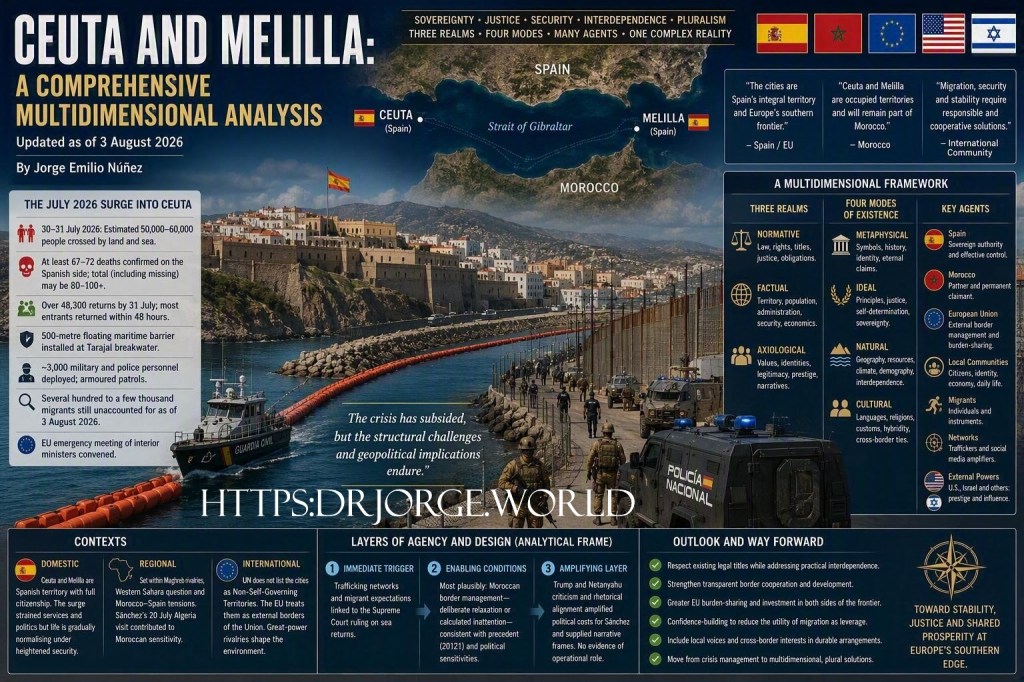
Ceuta and Melilla: A Comprehensive Multidimensional Analysis
By Jorge Emilio Núñez
Ceuta and Melilla, Spain’s autonomous cities on the North African coast, remain among the most sensitive territorial situations in Europe. As of 3 August 2026, the acute phase of the late-July migrant surge into Ceuta has largely subsided, yet the underlying dispute, structural vulnerabilities, and geopolitical implications persist. Between 30 and 31 July 2026 an estimated 50,000–60,000 people—predominantly young Moroccan men, with a smaller number of sub-Saharan Africans—crossed into Ceuta by land and sea. Official Spanish figures placed entrants at approximately 50,000; local authorities estimated closer to 60,000 in a city of roughly 83,000–84,000 residents. At least 67–72 deaths were confirmed on the Spanish side (recovery operations and reports from both sides suggest the total, including missing persons, may approach or exceed 80–100). The majority of arrivals returned voluntarily or under escort within 48 hours (Spanish Interior Ministry reported over 48,300 returns by the evening of 31 July), with continued returns thereafter. Crossings largely halted overnight into the weekend. Spanish authorities installed a 500-metre floating maritime barrier at the Tarajal breakwater, maintained a reinforced deployment of approximately 3,000 military and police personnel with armoured patrols, and continued searches for remaining individuals (estimates range from several hundred to a few thousand still present in hills, disused sites, and certain districts). Melilla experienced smaller, contained attempts and has returned closer to normal operations. An EU emergency meeting of interior ministers was convened in response.
This analysis integrates the multidimensional framework developed across my works—Sovereignty Conflicts and International Law and Relations: A Distributive Justice Issue (2017), Territorial Disputes and State Sovereignty: International Law and Politics (2020), and Cosmopolitanism, State Sovereignty and International Law and Politics: A Theory (2023, especially Chapter 6 on dimensions, variables, and the pluralism of pluralisms)—with the factual developments of the crisis, assessments of agency and design, and the situation as of early August 2026.
Agents and Their Roles
The dispute and the 2026 crisis involve a rich pluralism of agents. Spain acts as the sovereign authority exercising effective control, constitutional integration, and reinforced security measures. Morocco functions simultaneously as a migration-management partner and as the permanent claimant that regards the cities as “occupied” territory. The European Union is a structural agent: the cities constitute the EU’s only land borders with Africa, making their external-border regime a European concern. Local residents of Ceuta and Melilla (Spanish citizens of diverse ethnic and religious backgrounds) are the primary stakeholders of daily security, identity, and economic life. Migrants themselves occupy a dual role as individuals seeking opportunity or escape and as instruments in broader geopolitical contests. Trafficking networks and social-media amplifiers operated as immediate facilitators. External great-power actors—particularly the United States under President Donald Trump and Israel under Prime Minister Benjamin Netanyahu—shape the interpretive and prestige environment without proven operational involvement.
Roles are pragmatic, overlapping, and frequently nonlinear. Spain’s defensive and administrative role coexists with dependence on Moroccan operational cooperation for returns and border stabilisation. Morocco’s dual role as cooperative partner and leverage-wielder allows calibrated modulation of frontier permeability. Local communities navigate hybrid identities and economic interdependence while experiencing acute vulnerability during surges. External actors primarily exercise axiological and prestige influence: public criticism of Spanish migration policy and rhetorical alignment with Moroccan narratives amplify domestic political costs for the Spanish government without requiring direct operational direction.
Contexts: Domestic, Regional and International
Domestic context. Within Spain the cities are constitutionally integral territory with full citizenship rights and representation. The July surge overwhelmed services, hospitals, and reception capacity, prompting protests, political recriminations, and a temporary sense of abandonment among residents. As of 3 August streets and commercial activity are gradually normalising, yet the city remains under heightened security and many residents report lingering unease. National politics remains polarised: the government emphasises rapid reversal and cooperation with Morocco; opposition voices highlight sovereignty risks and alleged governmental weakness. In Morocco the cities feature in official narratives of territorial integrity and national prestige, particularly around Throne Day commemorations.
Regional context. The dispute sits within Maghreb geopolitics. Morocco’s claim is linked to its broader narrative of recovering territories and to the Western Sahara question. Algeria’s rivalry with Morocco, Spain’s balancing act between the two, and the strategic importance of the Strait of Gibraltar amplify tensions. Sánchez’s official visit to Algeria on 20 July 2026 (focused on energy cooperation) occurred against this background and is widely regarded by analysts as a contributing factor to Moroccan sensitivity. The crisis reinforced Morocco’s capacity to modulate pressure at the frontier while publicly cooperating on returns.
International context. The United Nations does not list Ceuta or Melilla among Non-Self-Governing Territories. Spanish sovereignty is recognised in practice by the vast majority of states and by European institutions. The EU’s emergency response underscores the European external-border dimension; no significant onward movement into mainland Schengen territory occurred. Great-power dynamics—U.S. and Israeli positions on Western Sahara, migration philosophy, and relations with Spain—shape the broader environment.
Realms: Normative, Factual and Axiological
Normative realm. Spain bases its title on historical acquisition (Melilla 1497 by Castile; Ceuta via Portuguese conquest in 1415 and consolidation under the Spanish Crown in 1580/1668), continuous effective occupation, treaties with pre-modern Moroccan entities, constitutional integration, and the absence of the cities from the UN decolonisation list. International law’s intertemporal principle evaluates titles according to the law of the time of acquisition. Morocco’s claim rests on geographic contiguity, post-colonial territorial integrity, and rejection of colonial-era arrangements. The 2026 events raise questions under the UN Charter (Article 2(4) on territorial integrity), the law of state responsibility, non-refoulement, and due process following a Spanish Supreme Court ruling limiting summary returns of sea arrivals. From a distributive-justice perspective (Sovereignty Conflicts, 2017), legal title strongly favours Spain, yet power asymmetries and migration leverage create practical inequities.
Factual realm. Spain exercises continuous administration, policing, and public services. The cities have EU external borders protected by fences, surveillance, and, after July 2026, a new maritime barrier. The surge demonstrated the permeability of the land-sea interface and the scale of potential pressure. Most arrivals returned rapidly, showing the practical limits of absorption. Residual presence of migrants, infrastructure strain, and the death toll constitute ongoing factual costs. Economic and social recovery remains partial as of early August.
Axiological realm. Spanish narratives emphasise historical continuity, democratic self-government, and European values. Moroccan narratives emphasise territorial integrity, anti-colonial justice, and national prestige. Local residents prioritise security, economic opportunity, and cultural hybridity. The crisis activated competing values of solidarity, sovereignty, and order. Leadership prestige on both sides of the Strait continues to shape responses.
Modes of Existence
Metaphysical. The cities carry symbolic weight: for Spain, historical continuity and European presence in Africa; for Morocco, unfinished decolonisation and national completion. These eternalist claims resist pure temporal compromise.
Ideal. Spain defends territorial integrity and the self-determination of its citizens. Morocco invokes post-colonial justice. Shared or limited-sovereignty arrangements remain theoretically possible but politically distant.
Natural. Geography dictates interdependence: short distances, shared maritime spaces, migration routes, and resource constraints. Climate and demographic pressures amplify contact and friction.
Cultural. Hybrid identities, bilingualism, religious diversity, and cross-border family and economic ties coexist with official national narratives. Daily practices of trade and labour create lived cosmopolitanism that official discourse often underplays.
Public International Law, Geopolitics, Leaders’ Prestige and the Question of Design
Public international law currently supports Spanish sovereignty through effective control, historical title, and the absence of UN decolonisation listing. Geopolitically the cities function as leverage points in Morocco–Spain relations, EU external-border management, and Maghreb rivalries.
The question of intentional design against Pedro Sánchez requires careful differentiation of layers of agency:
- The immediate factual trigger included trafficking networks and migrant expectations linked to the Supreme Court ruling on sea returns.
- Enabling conditions and scale are most plausibly explained by Moroccan border management—deliberate relaxation, selective non-intervention, or calculated inattention—consistent with historical precedent (notably the 2021 surge) and with regional prestige and Western Sahara sensitivities, including reaction to Sánchez’s Algeria visit. Spanish intelligence reportedly issued prior warnings of possible border “gestures.”
- Amplifying and interpretive layers involve pre-existing hostility from the Trump administration and the Netanyahu government toward Sánchez (over migration policy, NATO issues, Palestine recognition, and related matters), combined with strong U.S.–Israel–Morocco strategic alignment. Public criticism by Trump and rhetorical interventions by Israeli officials (including Ambassador Danny Danon’s comments on “colonial enclaves”) amplified domestic political costs for the Spanish government and supplied ready narrative frames. Former EU High Representative Josep Borrell observed that both Washington and Jerusalem would welcome difficulties for Spain, while explicitly stating he had no knowledge of any operational role.
There is no publicly available concrete evidence of direct operational direction, funding, or joint planning by the United States or Israel. Speculation remains at the level of motive alignment, rhetorical opportunism, and a permissive geopolitical environment. In the terms of Cosmopolitanism (2023), Trump and Netanyahu function primarily as prestige and axiological agents whose influence operates diagonally across contexts rather than as direct operational controllers of the surge.
Evaluation and Multidimensional Outlook as of 3 August 2026
The events of late July and early August 2026 confirm both the short-term resilience of Spanish effective control and the deeper structural vulnerability of the enclaves. Within days, the mass presence of tens of thousands of people was largely reversed through a combination of voluntary returns, escorted departures, physical barriers, and a substantial military and police deployment. This rapid containment demonstrates that Spain retains the capacity to reassert factual authority when pressed. At the same time, the scale, speed, and human cost of the surge—dozens of deaths, temporary demographic shock, and residual presence of hundreds or thousands of individuals—reveal how dependent that authority remains on Moroccan operational decisions at the frontier. The crisis therefore simultaneously reaffirmed sovereignty in practice and exposed its contingent character.
From the perspective of distributive justice developed in Sovereignty Conflicts (2017), the episode illustrates a persistent imbalance. Legal title, historical continuity, constitutional integration, and the absence of the cities from the United Nations list of Non-Self-Governing Territories strongly favour Spain. Yet geographic enclosure, demographic pressure, and the ability of the neighbouring state to modulate migration flows create practical inequities that pure legal entitlement does not resolve. The human cost borne primarily by migrants, the strain placed on local Spanish residents, and the political costs imposed on the Spanish government together constitute a distribution of burdens that the current international legal order does not adequately address. Justice in this setting cannot be reduced to the confirmation of existing titles; it must also engage the lived consequences of those titles under conditions of asymmetric vulnerability.
The sociological and identity dimensions emphasised in Territorial Disputes (2020) further complicate any simple resolution. Residents of Ceuta and Melilla navigate hybrid cultural, linguistic, and economic realities while remaining full Spanish citizens. The crisis intensified feelings of exposure and, in some quarters, abandonment, even as commercial life began to resume. Moroccan communities across the frontier experience the border as both opportunity and barrier. Any durable arrangement must therefore take seriously the plural local priorities—security, employment, family ties, and cultural recognition—rather than treating the cities solely as symbols in a state-to-state contest. Ignoring these local sociological components risks reproducing the pattern of provisional arrangements, relative calm, and renewed crisis that has characterised the relationship for decades.
The crisis also demonstrates the nonlinear and multi-scalar dynamics analysed in Cosmopolitanism (2023). What began as a local border incident rapidly acquired regional significance through Maghreb rivalries and Western Sahara sensitivities, European significance through Schengen and external-border concerns, and international interpretive significance through the rhetorical interventions of distant actors. Leadership prestige operated as a powerful self-referred variable: Moroccan narratives of territorial integrity, Spanish governmental claims of effective control, opposition critiques of weakness, and external commentary all shaped responses in ways that pure legal or security logic cannot fully explain. The interaction of these elements produced chaotic and regressive effects that linear diplomacy and reactive barrier-building are poorly equipped to manage over the long term.
Looking forward, sustainable management requires moving beyond containment toward the limited, shared, and plural arrangements advocated in the 2023 framework. Respect for existing legal titles remains essential; any solution that simply ignores Spanish sovereignty would itself constitute an injustice. Yet respect for titles must be accompanied by practical mechanisms that address interdependence: enhanced and transparent bilateral cooperation on border management and development, more equitable European burden-sharing and investment in both the cities and adjacent Moroccan regions, confidence-building measures that reduce the utility of migration as leverage, and institutional spaces in which local voices from both sides of the frontier can articulate economic and identity concerns. Physical barriers and military deployments can stabilise an acute phase; they cannot substitute for arrangements that integrate the full pluralism of agents, contexts, realms, and modes of existence. Without such evolution, the structural conditions that produced the July 2026 surge will remain in place, and similar nonlinear crises will remain probable. Ceuta and Melilla thus continue to illustrate both the limits of the current world order and the continuing need for multidimensional approaches capable of reconciling sovereignty with the complex realities of interdependence at Europe’s southern edge.
AUTHOR’S SAMPLE PEER-REVIEWED ACADEMIC RESEARCH (FREE OPEN ACCESS):
State Sovereignty: Concept and Conceptions (OPEN ACCESS) (IJSL 2024)
AUTHOR’S PUBLISHED WORK AVAILABLE TO PURCHASE VIA:
Monday 3rd August 2026
Dr Jorge Emilio Núñez
X (formerly, Twitter): https://x.com/DrJorge_World
 Dr Jorge's World