

Sovereignty as Risk Management: Navigating Fluid Realities in Contested Spaces
By Dr. Jorge Emilio Núñez
In the 21st century, sovereignty is not a border on a map; it is the capacity to maintain operational autonomy amidst structural volatility.
This simple yet powerful reframing lies at the heart of how businesses, governments, and leaders must approach territorial disputes today. For more than two decades, my research has explored sovereignty conflicts across the Americas, Asia, Europe, the Middle East, and beyond. Traditional legal and political thinking treats sovereignty as a static, absolute concept — a clear line determining who “owns” a territory. In practice, especially in contested spaces like the West Philippine Sea, the Middle East, or other hotspots, sovereignty has become fluid, dynamic, and deeply intertwined with business risk.
This article expands on the core message I delivered at the PROTECT 2026 conference in Makati, Philippines. It explains why the old paradigm is obsolete, introduces a multidimensional approach to sovereignty, and offers practical strategies for turning sovereign uncertainty into strategic resilience.
The Changing Nature of Sovereignty Disputes
Territorial disputes are no longer purely diplomatic or military matters. They are structural market risks that directly impact supply chains, physical assets, investment decisions, insurance premiums, and long-term profitability.
Consider the West Philippine Sea (South China Sea). Billions of dollars in annual trade pass through these waters. Disruptions — whether through physical confrontations, regulatory changes, or narrative campaigns — create immediate and cascading effects on global commerce. A single incident can delay shipments, spike commodity prices, raise insurance costs, or force companies to reroute operations at massive expense. Similar dynamics play out in the Middle East, where overlapping claims, hybrid threats, and great-power competition turn legal ambiguities into operational nightmares.
Traditional responses focus heavily on who has the legal right. International law, such as UNCLOS rulings, provides important rules and legitimacy. However, it is not a total shield. Enforcement is inconsistent, political will varies, and realities on the ground (or at sea) often evolve faster than legal processes. Companies and governments that rely solely on legal title expose themselves to hybrid risks: physical interference, reputational damage, regulatory surprises, and economic coercion.
Sovereignty today is fluid. It involves multiple agents (states, corporations, local communities, international organizations), overlapping contexts (legal, economic, technological, narrative), and evolving realities. This fluidity demands a new mindset: sovereignty as risk management.

Why the Static Model Fails in Practice
The classical Westphalian view of sovereignty assumes clear, indivisible authority within fixed borders. In contested zones, this assumption breaks down. Multiple claimants exercise varying degrees of control, and businesses operating in or near these areas face layered uncertainties:
- Physical and operational risks: Harassment of vessels, restricted access, or infrastructure disruptions.
- Economic and financial risks: Sudden changes in licensing, taxation, or resource access.
- Reputational and narrative risks: Disinformation campaigns that sway public opinion, investors, or regulators.
- Legal and regulatory risks: Overlapping claims create ambiguity about which jurisdiction’s rules apply.
Recent examples from the South China Sea illustrate how these risks materialize. Repeated incidents involving fishing vessels, coast guard actions, and maritime militia have disrupted exploration activities and raised insurance premiums for shipping.
Global supply chains, already strained by other geopolitical tensions, become even more vulnerable when critical chokepoints turn volatile.
Businesses cannot afford to treat these as external “political” issues separate from core strategy. Sovereign uncertainty has become an enterprise risk that must be managed like currency fluctuation, cyber threats, or climate impacts.
A Multidimensional Framework for Understanding Sovereignty
My research advocates moving beyond zero-sum thinking toward a multidimensional approach. This framework analyzes sovereignty disputes through three interconnected lenses:
- Agents: Not only states, but corporations, NGOs, local populations, and even technology platforms play active roles.
- Contexts: Disputes unfold domestically, regionally and globally.
- Realms: Rational calculations, empirical facts on the ground, ethical considerations, and emotional/narrative elements all matter.
- Mode of existence: Disputes unfold simultaneously in legal, political, economic, cultural, and technological dimensions.
This “pluralism of pluralisms” recognizes that absolute sovereignty is often aspirational rather than realistic in contested spaces. Acknowledging this complexity opens pathways for practical management rather than endless confrontation.
For businesses, the multidimensional view translates into better risk assessment. Instead of asking only “Is this legally ours?” leaders should ask:
- What are the overlapping claims and control realities?
- How might different agents (including non-state actors) influence outcomes?
- What economic, narrative, or technological levers can create stability or advantage?
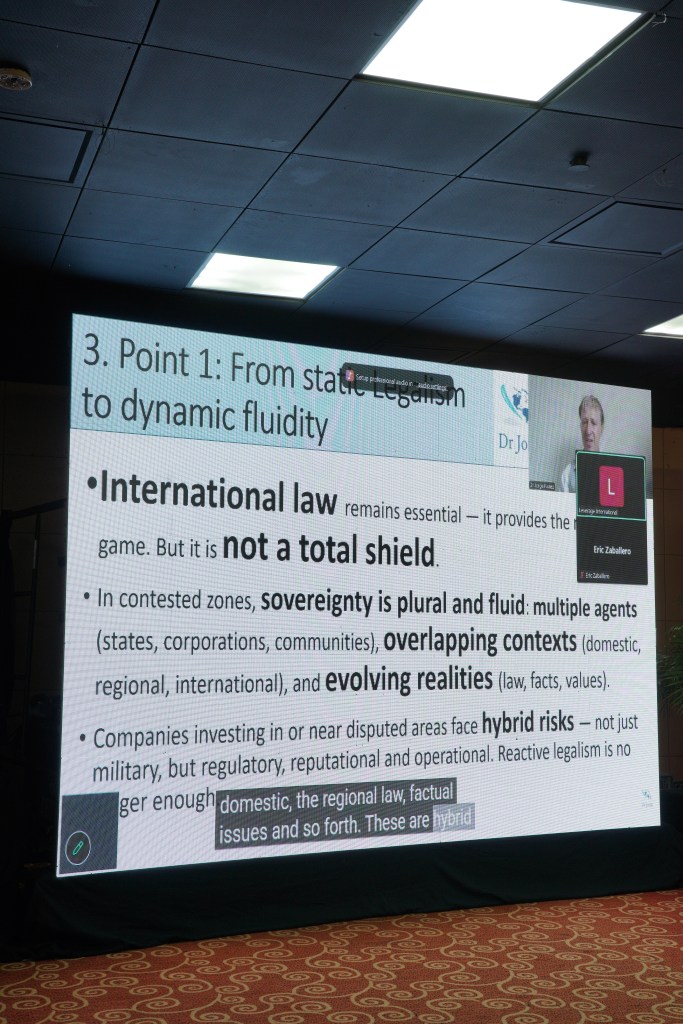
From Reactive Legalism to Proactive Strategic Resilience
The practical shift required today is from reactive legalism to proactive strategic resilience. Here are key recommendations for businesses and policymakers operating in or near disputed territories:
1. Conduct Multidimensional Risk Assessments
Go beyond standard due diligence. Map not only legal claims but political trends, narrative dynamics, economic interdependencies, and potential hybrid threats. Scenario planning should include best-case, worst-case, and “gray zone” middle scenarios. Regularly update these assessments — the situation in contested spaces can shift rapidly.
2. Build Operational Redundancy and Flexibility
Diversify supply chains, maintain alternative routing options, and avoid over-reliance on single points in contested zones. Companies successful in high-risk environments often use modular operations that can adapt quickly when access is restricted.
3. Engage in Smart Partnership and Intelligence Sharing
Public-private collaboration is essential. Businesses should develop trusted channels with governments for timely intelligence while protecting commercial sensitivities. Joint scenario exercises and information-sharing platforms can significantly improve preparedness.
4. Integrate Geopolitical Foresight into Core Strategy
Treat sovereignty risk as a board-level issue, not something delegated only to legal or security teams. Incorporate it into investment decisions, insurance strategies, and long-term planning. Political risk insurance and hedging instruments remain valuable but work best when combined with proactive mitigation.
5. Leverage International Law Strategically
View law as rules of the game rather than a guaranteed shield. Use arbitral awards, diplomatic initiatives, and multilateral forums to strengthen legitimacy and create leverage, while preparing operational plans that do not depend solely on enforcement.
6. Manage Narrative and Reputational Dimensions
In today’s information environment, how a dispute is perceived matters almost as much as physical control. Companies should monitor and, where appropriate, engage with narratives that affect investor confidence and stakeholder trust.
Real-World Implications and Opportunities
Companies that master this approach can transform potential vulnerability into competitive advantage. Those with robust resilience frameworks often secure better financing terms, attract quality partners, and maintain operational continuity when others are forced to withdraw.
In the Philippines context, for example, businesses that integrate West Philippine Sea realities into their planning — through diversified maritime logistics, local partnerships, and scenario readiness — position themselves to thrive even amid tensions. The same logic applies globally.
My forthcoming and existing works, including Territorial Disputes in the Americas and earlier books on sovereignty conflicts, provide detailed case studies showing how multidimensional thinking reveals non-zero-sum opportunities.
The Path Forward: Shared Horizons
Sovereign disputes will not disappear. Great-power competition, resource demands, and technological advances will likely intensify pressures in contested spaces. The winners will be those who stop treating sovereignty as a fixed possession and start managing it as dynamic
Business leaders: Incorporate geopolitical foresight into your DNA.
Policymakers: Create frameworks that encourage responsible private-sector resilience while protecting national interests.
Academia and thought leaders: Continue bridging theory and practice.When we embrace sovereignty as risk management, we move from paralysis and confrontation toward calculated, resilient progress. Uncertainty becomes navigable. Volatility reveals opportunity for those prepared to operate within it.
This is not wishful thinking. It is a strategic imperative for the 21st century.I invite readers to continue this conversation. Whether through my upcoming two-day workshop in Athens, tailored consultancy programs, or executive coaching, I work with leaders and organizations seeking to master these complex dynamics.
Contact me at drjorge.world to explore how multidimensional sovereignty frameworks can strengthen your strategic resilience.
The future belongs to those who understand that sovereignty is not merely claimed — it is actively managed.
Consultancy and Coaching (Including Upcoming Workshops)
https://drjorge.world/contact/
Related Content
AUTHOR’S SAMPLE PEER-REVIEWED ACADEMIC RESEARCH (FREE OPEN ACCESS):
State Sovereignty: Concept and Conceptions (OPEN ACCESS) (IJSL 2024)
AUTHOR’S PUBLISHED WORK AVAILABLE TO PURCHASE VIA:
Tuesday 19th May 2026
Dr Jorge Emilio Núñez
X (formerly, Twitter): https://x.com/DrJorge_World

