
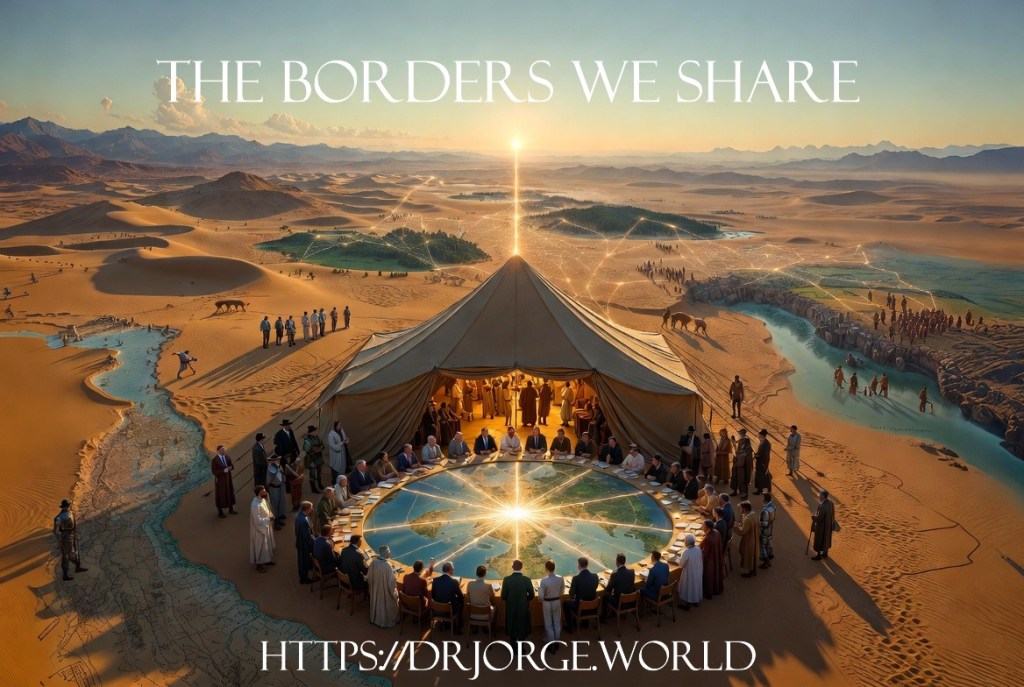
The Borders We Share: A New Way to Fix a Broken World
Bonus Post: Sands of Unity Revisited – A Multidimensional Tale of the Middle East in Early 2026
This bonus post is written as part of The Borders We Share series to reflect on the ongoing situation in the Middle East. It draws inspiration from the original “Sands of Unity” bonus post published in June 2025, which used allegory, dialogue among leaders and faith figures, and multidimensional shared-sovereignty ideas to explore Israel-Palestine, Iran, Lebanon, and broader regional tensions. The aim here is to update that framework with the latest developments as of March 2026—fragile Gaza ceasefire, Iranian protests and crackdowns, continued Lebanon strikes, stalled Phase 2 talks, and U.S. regional diplomacy—while reaffirming the series’ core vision: that borders and disputes can be transformed through egalitarian shared sovereignty, dialogue, and moral equality rather than zero-sum conquest. By revisiting the “sands” as a living metaphor, we seek not to predict outcomes but to hold space for possibilities grounded in justice, security, and human dignity for all who call this region home. In doing so, the post continues the series’ commitment to reimagining territorial conflicts not as inevitable tragedies but as opportunities for creative, equitable coexistence.
The Current Landscape: Fragile Ceasefires and Lingering Storms
The desert air still shimmers, but the heat carries a different weight in early 2026. The sands of the Middle East have shifted again—some dunes stabilized by fragile ceasefires, others stirred by new storms of protest, airstrikes, and stalled diplomacy. In Gaza, the October 2025 ceasefire has largely held, allowing the return of most hostages and a partial Israeli withdrawal from parts of the territory. Yet Israel maintains control over more than half of Gaza, continues targeted operations against remaining Hamas infrastructure, and insists on security guarantees before any further pullback. Humanitarian conditions have improved slightly, with more aid entering through reopened crossings, but winter cold bites through makeshift tents, fuel shortages persist, and international organizations report that reconstruction remains painfully slow. Phase 2 of the U.S.-brokered plan—full demilitarization, governance reform under a technocratic Palestinian administration, and large-scale rebuilding—remains stuck, with Hamas refusing complete disarmament and Israel delaying major withdrawals until all provisions are verified by international monitors.
In Lebanon, Israeli strikes on Hezbollah targets and weapons caches continue despite the November 2024 ceasefire, while Beirut struggles with disarmament talks, economic collapse, and internal political deadlock. Iran faces nationwide protests sparked by currency collapse, fuel shortages, and economic strain, met with lethal crackdowns by security forces; external pressures mount as the U.S. and Israel weigh further action against its nuclear program and regional proxies. The broader region—Syria’s fragile transition after the fall of Assad, Yemen’s proxy rivalries, and Gulf dynamics—remains tense, with the Trump administration positioning itself as both guarantor and broker through initiatives like the “Board of Peace” and renewed normalization talks with Saudi Arabia.
These developments echo the original Sands of Unity post, where we gathered leaders and faith figures in a desert tent to debate self-defense, occupation, hostages, and genocide fears through multidimensional lenses—linear hierarchy versus nonlinear cycles of justice and healing. Moses, Jesus, and Mohammed invoked scripture to challenge division, calling for covenant renewal, new hearts, and cooperation. The council proposed shared zones, resource splits, hostage negotiations, and a “Desert Passport” for unified movement. Today, with the sands shifting once more, we return to that tent—not to rewrite history, but to listen again to the same voices amid new realities, asking what shared sovereignty might look like when ceasefires hold but trust remains fragile, when protests shake regimes but repression answers, and when reconstruction plans exist on paper but implementation stalls on the ground.
Gathering the Voices: Leaders, Elders, and the People
Imagine the tent once more, pitched where the dunes of Gaza meet the broader Middle Eastern expanse. The canvas flaps in the same desert wind, but the voices inside carry updated urgency and exhaustion.
Netanyahu sits with the weight of ongoing security concerns and domestic politics: “We have stopped the wholesale bombing, returned most hostages, and begun withdrawal. But Hamas remains in parts of Gaza, and threats from Hezbollah and Iran persist. Security is not negotiable when survival is at stake. We cannot allow October 7 to repeat. Every concession must be matched by verifiable disarmament and governance reform.”
A Palestinian voice—echoing Abbas or a Gazan mother—responds with quiet pain: “We have seen over 70,000 of our people killed since 2023. The ceasefire brought relief, but half our land remains under your control, aid is restricted, and winter bites through tents. We seek not revenge but dignity—a state where our children can live without fear of demolition or blockade. Occupation and settlement expansion steal our future. How can we trust when every step forward is met with new conditions?”
An Iranian dissident voice, representing the protests that erupted in late 2025 and continue into 2026, rises with urgency: “Our currency has collapsed, our streets fill with demonstrators demanding bread and freedom, and the regime answers with lethal force. External threats and sanctions tighten the noose, yet the people cry for change from within. We do not want war with Israel or the West—we want a future where our children are not pawns in regional games. The hardliners use your bombs as excuses to crush us at home.”
A Lebanese representative adds, tone heavy with exhaustion: “Hezbollah’s weapons remain a shadow over our sovereignty. Israeli strikes continue despite the ceasefire, while our economy collapses. Disarmament talks stall because trust is broken on all sides. We need a path where Lebanon is not a battlefield for others’ wars, where our people can rebuild without fear of the next explosion.”
The U.S. envoy, channeling Trump-era diplomacy, interjects with pragmatic firmness: “Phase 2 of the Gaza plan offers reconstruction—towers, data centers, resorts—if Hamas disarms and a technocratic government takes hold. The Board of Peace stands ready to supervise. But violations and delays test our patience. Regional normalization, including with Saudi Arabia, requires concrete steps toward security and coexistence. We are here to broker, not to dictate, but the window is narrowing.”
Moses steps forward, as he did in the original sands, his voice carrying the weight of exodus and covenant: “Remember the stranger in your midst. Do not oppress the widow, the orphan, the displaced. Justice without crushing the vulnerable—that is the command. The desert taught our ancestors that water shared sustains all; water hoarded dries the well for everyone.”
Jesus speaks softly, his words gentle yet piercing: “Blessed are the peacemakers. Turn the other cheek not in weakness but in strength that breaks cycles of retaliation. Love your neighbor as yourself—even when the neighbor’s pain mirrors your own. The kingdom is not built on walls but on tables where enemies become guests.”
Mohammed’s voice resonates with clarity and compassion: “Repel evil with what is better. Unity is strength; division invites destruction. The desert teaches us that water shared sustains all; water hoarded dries the well for everyone. Let us build bridges of trust where walls once stood, and let justice flow like a river that nourishes every bank.”
Deepening the Dialogue: Pain, Security, and Shared Futures
The council deepens. A Gazan mother describes winter tents and restricted aid: “We returned hostages in good faith. Now let the blockade lift fully, let reconstruction begin without preconditions that feel like surrender. My children deserve to grow up without the sound of drones overhead.” A settler voice from the West Bank counters: “Security is our daily prayer. Every rocket, every stone, every tunnel reminds us why we cannot risk another October 7. We want peace, but peace must include the right to live without fear in our ancestral homes.”
An Iranian protestor adds: “Our streets bleed not from Israeli bombs but from our own regime’s fear of change. Sanctions hurt the people more than the leaders—yet external threats give the hardliners excuses to crush us. We want bread, freedom, and dignity, not endless war.”
A Lebanese voice continues: “Hezbollah’s weapons remain a shadow over our sovereignty. Israeli strikes continue despite the ceasefire, while our economy collapses. Disarmament must be paired with Israeli withdrawal from southern outposts and respect for our sovereignty. We cannot be the battlefield for others’ wars.”
Holmes leans forward, ever the detective, eyes sharp: “The evidence is clear on all sides—hostages returned, yet control remains; protests suppressed, yet grievances fester; strikes continue, yet ceasefires hold by a thread. The pattern is one of mutual fear sustaining mutual harm. The solution lies not in victory but in verifiable, mutual steps: full Phase 2 implementation with international oversight, gradual disarmament tied to security guarantees, economic incentives for cooperation, and a genuine political horizon for Palestinian statehood alongside Israeli security.”
Watson notes the human cost with quiet sorrow: “Over 70,000 dead in Gaza since 2023, hundreds more in Lebanon and Iran’s streets, millions displaced or living in limbo. The numbers do not lie—war devours the innocent while leaders debate red lines. We must find a way where security and dignity are not enemies but partners.”
Arthur places Excalibur flat on the tent floor: “A round table is not weakness. It is the courage to see the other as human. Let every voice rest here, and let the desert judge what is just.”
Practical Proposals for Egalitarian Shared Sovereignty
The dialogue turns practical. Proposals echo the original Sands of Unity but updated for 2026 realities:
- A strengthened “Board of Peace” with broader Arab and international participation to supervise Gaza reconstruction and Phase 2 disarmament/governance.
- Cross-border economic zones along the Sinai and Lebanon borders, with revenue sharing for joint infrastructure and job creation.
- A “Desert Passport” initiative for eased movement between Gaza, West Bank, Israel, and neighboring states, tied to security vetting and economic contribution.
- Resource-sharing pacts for Nile, Jordan River, and shared aquifers, modeled on successful Latin American guarantor mechanisms.
- Pilot shared heritage and environmental projects in the West Bank and Sinai to build trust through tangible cooperation.
Netanyahu, after listening: “Security guarantees must be ironclad. If Hamas disarms and a technocratic government emerges, we can discuss further withdrawals.”
A Palestinian leader responds: “Statehood and dignity are not bargaining chips. End settlement expansion, lift restrictions, and let us govern ourselves. Then trust can grow.”
An Iranian voice: “Lift sanctions that crush the people, not the regime. Allow internal reform without external pretexts for crackdown.”
A Lebanese voice: “Disarmament must be paired with Israeli withdrawal from southern outposts and respect for our sovereignty.”
The council does not end in full agreement—real wounds do not heal in one sitting. Yet seeds are planted: conditional steps, third-party monitoring, economic incentives, and faith-based calls for justice and mercy. The tent flaps in the wind, but the conversation continues.
Reflections on the Sands of Unity
As in the original Sands of Unity, the desert teaches us that water shared sustains all; water hoarded dries the well for everyone. In 2026, with ceasefires holding by threads, protests shaking regimes, and reconstruction plans stalled in Phase 2, the same multidimensional truth holds: linear hierarchies of power must yield to nonlinear cycles of healing. Shared sovereignty—equal participation, efficiency, equilibrium—offers not utopia but a practical path: verifiable disarmament tied to security guarantees, economic zones that benefit all, residency and movement rights that honor contribution, and joint courts that protect dignity.
The Middle East in early 2026 remains fragile—Gaza’s ceasefire tested by violations, Iran’s streets tense with protest and repression, Lebanon’s disarmament talks stalled, regional proxy rivalries simmering. Yet the sands of unity still shift. The series has always insisted that borders are stories we tell—and stories can be rewritten. Let this bonus post stand as invitation: not to ignore pain or security needs, but to imagine a Middle East where no child grows up behind a welded shutter, no mother carries a key to a house she cannot reach, no scholar measures stars while forgetting the earth below.
The desert waits. The tent remains open. The conversation continues.
I remain, as always,
Dr. Jorge
Trails to Wander:
• Sovereignty Conflicts (2017).
• Territorial Disputes (2020).
• Cosmopolitanism and State Sovereignty (2023).
• Territorial Disputes in the Americas (2025).
NOTE: New posts every Tuesday.
PREVIOUS POSTS:
The Borders We Share: The Sands of Unity: A Multidimensional Tale of the Middle East (Bonus Post)
Bonus Post: A Tapestry of Shared Horizons – Summing Up The Borders We Share (Sections 1–7)
Section 7 Recap: Deserts and Plains (Posts 37–42)
NEXT POSTS:
Section 8: Rivers and Flows (Posts 43–48)
43, Sherwood’s Stream, Nile’s Flow: Green to Blue
44, Laputa’s Falls, Mekong’s Rush: Sky to Stream
45, Utopia’s Banks, Indus’ Bend: Perfect Waters
46, Ruritania’s Tide, Danube’s Dance: Crowns of Current
47, Narnia’s Run, Euphrates’ End: Royal Rivers
48, Cimmeria’s Flood, Amur’s Edge: Dust Washes East
AUTHOR’S SAMPLE PEER-REVIEWED ACADEMIC RESEARCH (FREE OPEN ACCESS):
State Sovereignty: Concept and Conceptions (OPEN ACCESS) (IJSL 2024)
AUTHOR’S PUBLISHED WORK AVAILABLE TO PURCHASE VIA:
Tuesday 31st March 2026
Dr Jorge Emilio Núñez
X (formerly, Twitter): https://x.com/DrJorge_World
 Dr Jorge's World