
The Borders We Share: A New Way to Fix a Broken World
Section 7: Deserts and Plains (Posts 37–42)
Post 42: Laputa’s Dunes, Part II: Quantum Sands
Enigma of the Entangled Horizon
The wind has learned to speak in echoes.
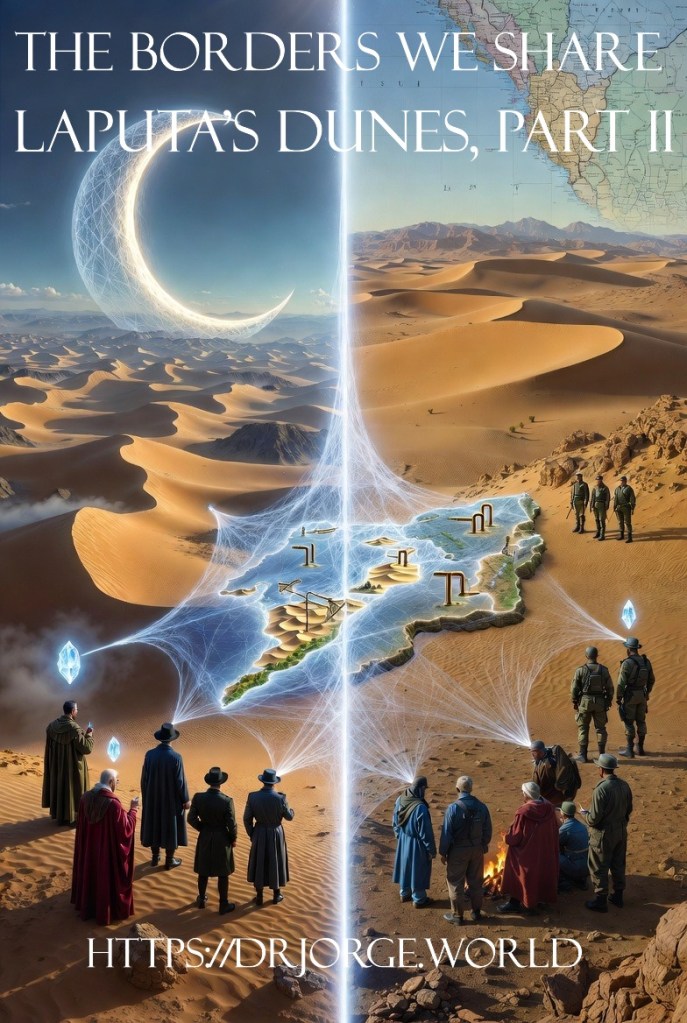
Two deserts remain distinct, yet their fates have become entangled beneath the same unblinking sun.
The first is Laputa’s Waste, the crescent band of dunes that formed on the island’s lower rim when the crystal extractions began—sand that moves in slow, deliberate spirals, as though remembering every grain that fell from the floating disc above. The second is the Sahara that stretches beneath it, a golden sea of sand that covers 9.2 million square kilometres from the Atlantic to the Red Sea, where dunes rise and fall like slow-breathing creatures and where the same wind that stirs Laputa’s Waste now carries grains across borders drawn by men who rarely walk the sand.
Both deserts are vast.
Both are contested.
Both are bleeding into one another through the invisible threads of wind and magnetic drift.
Both are claimed by powers that can no longer pretend the sand stays in one place.
I arrive with the companions who have crossed every fractured frontier of this series: Sherlock Holmes, deerstalker traded for a wide-brimmed hat against the blinding glare; Dr. John Watson, notebook curling at the edges from the dry heat; King Arthur, who has swapped mail for a plain wool cloak but still carries Excalibur at his side like a vow that no desert can erase.
With us walk the people who belong to each desert separately.
From Laputa’s Waste come the exiled cartographers who first mapped the dunes; the dune nomads who live between oases that appear and vanish with the magnetic tides; the young Laputan dissident who first called the Waste “the People’s Sky-Desert.”
From the Sahara come the Polisario commander who has lived in the liberated zone for forty years; the Moroccan administrator from Laayoune; the Tuareg trader who crosses borders daily; and Hamed al-Ghabri, the Omani elder whose water-bag has become a symbol of cross-border memory.
This is Post 42, the sixth and final stride in Section 7: Deserts and Plains. We have left the bleeding grasslands of Cimmeria and the steppe, the unclaimed horizons of Erewhon and Sinai, the crowned voids of Narnia and Sudan. Now the series returns to the dunes, but they are no longer the same dunes. The quantum sands have entangled Laputa and the Sahara, myth and map, until the question is no longer “who owns the sand” but “what happens when the sand itself refuses to stay in one place?”
I. Laputa’s Waste – The Floating Desert
Laputa’s Waste is the narrow crescent of dunes that formed on the island’s lower rim when the crystal extractions began in the 19th century. The scholars call it an inevitable by-product of levitation; the exiled cartographers call it theft. Every year approximately 18,000 tonnes of sand are lost to wind and rockfall, carried downward to Balnibarbi below, where they bury fields and clog wells. The island’s magnetic field keeps the dunes in perpetual slow motion—beautiful to watch from above, terrifying to live beneath. No one from the upper city has set foot there in living memory. The nomads who do live there have no representation in the royal academy. They are not citizens; they are ballast.
The dunes have begun to change. Grains from the Sahara have risen on magnetic currents to mingle with Laputa’s own; grains of Laputa’s Waste have fallen to join the Sahara below. The boundary is no longer fixed. A single dune can contain particles from Tindouf and the underside of the floating disc; a single gust can carry a memory from the Berm to the royal academy and back again. The nomads no longer speak of “upper” and “lower”—they speak of “the Dunes” as one continuous body. The scholars above still pretend the Waste is separate; the people below know better.
II. The Sahara – The Grounded Desert
The Sahara is brutally real. It stretches 9.2 million square kilometres from the Atlantic to the Red Sea, a golden sea of sand that has swallowed empires and spit out bones older than memory. The Western Sahara portion remains the most contested: since Spain’s withdrawal in 1975, Morocco has administered roughly 80 % of the territory, while the Polisario Front controls the remaining 20 % east of the Berm—a 2,700-kilometre sand wall built by Moroccan forces in the 1980s and 1990s. The United Nations still lists Western Sahara as a non-self-governing territory. Morocco has invested heavily in infrastructure in the “Southern Provinces,” building roads, ports, and desalination plants; the Polisario accuses Morocco of resource plunder (phosphates, fisheries, potential offshore oil). The Sahrawi refugee population in Tindouf camps exceeds 173,000 (UNHCR 2025). Water is the true currency: the territory sits atop one of the world’s largest fossil aquifers, yet access is tightly controlled. Both sides claim the dunes by history; both sides suffer from their aridity.
The dunes have begun to change here too. Laputa’s pull has stretched Saharan sand northward and upward; Saharan grains now dust the underside of the floating island. The wind carries them back and forth in a slow, inevitable exchange. The border is no longer a line on a map—it is a membrane that breathes. Both deserts are bleeding into one another; both are claimed by powers that can no longer tell which sand is theirs.
III. The Mirror They Hold Up
Sovereignty Conflicts frames both as classic triadic disputes: two privileged claimants exercising sovereignty over a populated third territory whose constitutive population is treated as peripheral to the claim yet suffers the direct environmental and economic cost.
Territorial Disputes adds the sociological fracture: upper-city scholars versus underside exiles; Moroccan settlers versus Sahrawi who remain in the territory or live in exile.
Cosmopolitanism and State Sovereignty asks the moral question: can a claim to land be legitimate when the land itself refuses to stay in one place?
Territorial Disputes in the Americas provides the practical precedent: guarantor-led shared-resource zones that have achieved high durability in Latin American cases—models now urgently needed here, but for a border that is no longer fixed.
IV. The Evidence Carried in Quantum Sand
Holmes refuses to stay aloft. He spends four days walking Laputa’s Waste with the nomads, measuring wind speed, dune migration rates, and the interval between Laputa’s magnetic pulses and the sudden gusts that carry sand downward. He spends the next four days crossing the Berm with Polisario escorts and Moroccan liaison officers, timing the movement of sand grains between the two deserts. The data he returns with are entangled.
In Laputa’s Waste 18,000 tonnes of sand are lost annually to wind and fall; 2,900 nomad families displaced in the last decade. In the Sahara 17,800 tonnes of phosphate rock are exported annually from Moroccan-controlled zones; 173,000 Sahrawi refugees still in Tindouf after fifty years. In Laputa zero scholars have visited the Waste in living memory; in the Sahara zero high-level officials have entered the liberated zone since 1991. But now grains from Tindouf lie on Laputa’s underside, and grains from the floating disc lie on the Berm.
Watson’s notebook grows heavy: “The sand no longer respects borders. It has become its own border—a living line that moves with every breath of wind.”
Arthur stands on a dune that is half Laputa and half Sahara, watching grains from both deserts swirl together in the same gust. He says only: “A desert does not care who claims it. It only remembers who walked it together.”
V. The Council Where Sand Meets Sand
We meet where the two deserts have begun to merge: a neutral crest on Laputa’s lowest dune, lowered to within 150 metres of the Sahara’s surface for the first time in history, with Moroccan, Sahrawi, and Laputan representatives brought by helicopter and dune nomads arriving on foot.
Present: King Laputian, seated on a portable throne of adamant, visibly uncomfortable at being so close to earth; Balnibarbi, barefoot on real sand, eyes shining; the Polisario commander who has lived in the liberated zone for forty years; the Moroccan administrator from Laayoune; Mohammed Yusuf, the Pakistani steel-fixer now working on a cross-desert recharge project; Hamed al-Ghabri, the Omani elder whose water-bag now holds sand from both deserts.
Balnibarbi speaks first: “The dunes are no longer separate. They are one body now, breathing with two hearts.”
The Polisario commander answers: “Our dunes have been moving under foreign boots for fifty years. We ask only for the right to walk them freely.”
The Moroccan administrator, voice calm: “We have brought water, roads, schools. The dunes are more alive now than they have ever been.”
The young Laputan dissident, voice sharp: “The sand has already decided. It belongs to no one and to everyone. Let us listen to what it has chosen.”
The Sahrawi refugee, holding her key tightly: “I carry the key to a house I have never seen. The sand remembers the door even if the map does not. It remembers the children who played in the courtyard, the songs my mother sang at dusk, the smell of bread baked in the clay oven. It remembers everything we lost when the border was drawn through our lives.”
The Moroccan administrator, after a long silence: “We built schools so those children could learn. We built roads so they could travel. We built wells so they would not thirst. The sand remembers that, too.”
Balnibarbi, gentle but firm: “It remembers both. It remembers the schools and the roads, and it remembers the keys that no longer open doors. The sand does not choose sides. It only asks that we stop making it choose.”
The Polisario commander, voice low: “Fifty years ago we walked these dunes as free people. We carried our tents and our children and our stories. Now the dunes carry our stories for us, because we cannot carry them ourselves. The sand has become our memory when we were forced to forget.”
Hamed al-Ghabri lifts his water-bag: “In Oman we say the desert is a mirror. It shows you what you bring to it. If you bring greed, it gives you thirst. If you bring sharing, it gives you life.”
King Laputian, voice cracking from the unaccustomed dryness: “Our crystals keep us aloft, but we have forgotten how to land. Perhaps the sand will teach us.”
The Sahrawi refugee, eyes on the horizon: “Teach us? No. Let us teach you. The sand does not need teaching. It needs resting. It needs walking. It needs remembering.”
Arthur’s voice, quiet as a vow: “A sword laid flat is not surrender. It is invitation. Let every hand rest here, and let the sand judge.”
The “Quantum Sands Accord” is drafted in sand and ink:
Joint Laputa–Sahara Quantum Sands Commission with binding extraction and migration caps; surplus funds a cross-desert aquifer recharge programme and nomadic resettlement.
The merged dunes declared a shared ecological and cultural zone; 40 % of crystal and phosphate revenue funds permanent descent corridors, grounded universities, and cross-border schools.
“Sand-to-Sky Residency Pathway”: ten continuous years of contribution (nomadism, scholarship, land restoration) = permanent residency in Morocco or citizenship on Laputa’s grounded ring.
Higher Court seated alternately in Laayoune and on Laputa’s lowest terrace, with judges from Moroccan, Sahrawi, expatriate, and Balnibarbi communities; veto power on any project that depletes aquifers or accelerates dune migration.
Every new mining or recharge operation must display, in Arabic, Hassaniya, Spanish, Urdu, and Balnibarbi dialect, the source of the water and the names of the nomads and workers who sustain it.
King Laputian signs first, his hand steady because it rests on real sand. The Polisario commander signs second. The Moroccan administrator signs third. Mohammed Yusuf signs fourth. Balnibarbi signs last—his bare foot pressing the parchment into the dune as seal.
Murmurs of the Quantum Wind
The wind still carries warnings: aquifers will fall, dunes will migrate, people will thirst. Yet it also carries new notes: the soft hiss of a recharge well pumping water back into the ground, the laughter of Sahrawi and Laputan children learning dune navigation together on a neutral crest, the quiet thud of a Laputan astronomer choosing to walk rather than float, the rustle of a water-bag being refilled from a tap that no longer runs dry.
Peace along this entangled frontier is not a treaty signed in air-conditioned halls. It is a grain of sand left undisturbed so a palm grove may breathe again, a path reopened so a nomad may walk it freely, a desert whose horizon is wide enough for every exile and every scholar to stand beneath the same sky.
Why This Resonates in You
You have stood in a desert so quiet you could hear your own heartbeat.
You have looked at a map and wondered why one side of a line is marked in green and the other in brown.
You have, perhaps, never met the nomad whose path was closed so a border could stay open, the scholar who learned that the stars are beautiful but the sand is home, or the elder who discovered that even a king can learn to walk.
The Borders We Share asks only one thing: the next time you look at a desert, remember there is always a ground—and that the ground remembers every footprint, every promise kept or broken.
This concludes Section 7: Deserts and Plains. The journey continues in future sections. I’m Dr. Jorge, shaping these tales into a book you’ll cradle. Visit https://drjorge.world or X (https://x.com/DrJorge_World )—join me from Laputa’s dunes to the Sahara’s sands, sowing seeds for thriving deserts. Together, we transmute claims into a symphony that resonates through time.
Trails to Wander:
• Sovereignty Conflicts (2017).
• Territorial Disputes (2020).
• Cosmopolitanism and State Sovereignty (2023).
• Territorial Disputes in the Americas (2025).
NOTE:
New posts every Tuesday.
PREVIOUS POSTS:
Post 41: Oz’s Plains, Outback’s Reach: Emerald to Dust
NEXT POSTS:
Section 7 Recap: Deserts and Plains (Posts 37–42)
AUTHOR’S SAMPLE PEER-REVIEWED ACADEMIC RESEARCH (FREE OPEN ACCESS):
State Sovereignty: Concept and Conceptions (OPEN ACCESS) (IJSL 2024)
AUTHOR’S PUBLISHED WORK AVAILABLE TO PURCHASE VIA:
Tuesday 17th February 2026
Dr Jorge Emilio Núñez
X (formerly, Twitter): https://x.com/DrJorge_World
 Dr Jorge's World
[…] The Borders We Share: Laputa’s Dunes, Part II (Post 42) […]
LikeLike