
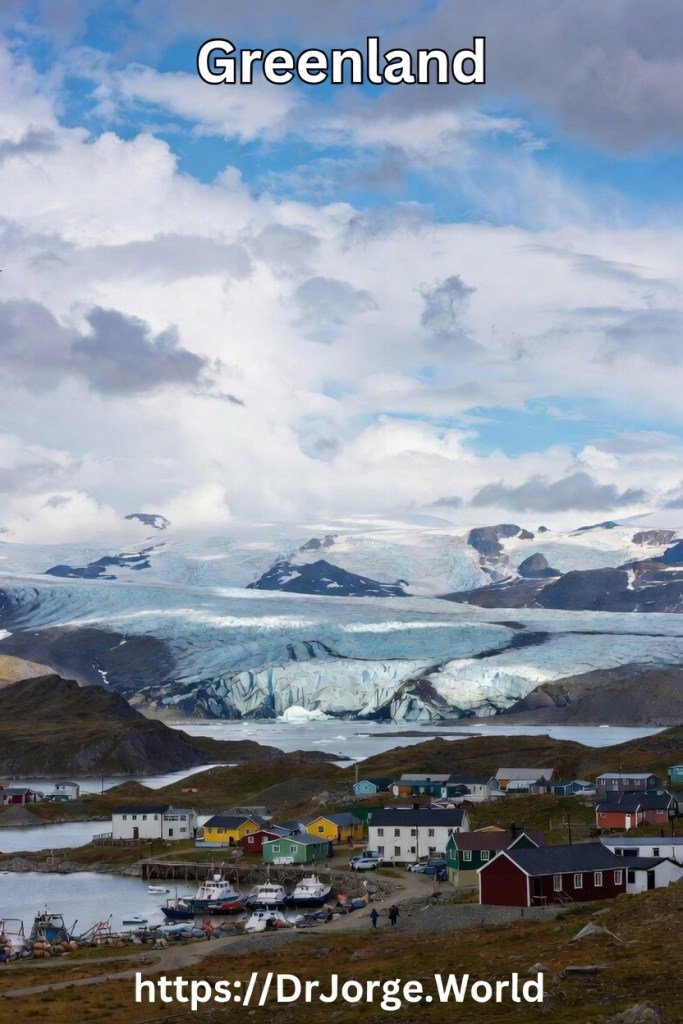
What would happen if Trump took over Greenland?
Donald Trump’s renewed push to acquire Greenland—first floated in 2019 and aggressively revived in early 2025—has escalated from a provocative real-estate metaphor into a serious geopolitical challenge. As of mid-January 2026, the White House has openly discussed “all options,” including economic coercion, direct payments to Greenlanders, and even military force. Vice President JD Vance hosted Danish and Greenlandic officials for talks on January 14, 2026, while Trump has called anything less than U.S. control “unacceptable,” threatened tariffs on Denmark, and refused to rule out “the hard way” if Denmark and Greenland resist (Reuters, January 12, 2026; Guardian, January 13, 2026). Greenland’s Prime Minister Jens-Frederik Nielsen and Denmark’s Prime Minister Mette Frederiksen have responded firmly: “Greenland is not for sale” and “no more fantasies of annexation” (BBC, January 5, 2026; CNBC, January 13, 2026). A January 2026 poll showed 85% of Greenlanders oppose joining the U.S. (Berlingske, 2026).
My trilogy provides a structured way to think through this scenario. In Sovereignty Conflicts and International Law and Relations: A Distributive Justice Issue (2017), I argue that territorial claims are fundamentally distributive justice problems—who gets what, and on what basis of fairness? Greenland is not an empty landmass; it is home to 57,000 people, mostly Inuit, with their own history, culture, language, and aspirations for greater autonomy or independence. Any U.S. takeover—whether by purchase, coercion, or military pressure—would immediately raise the question of distributive justice for the Greenlandic people, not just for Denmark or the United States. The 2009 Self-Government Act already grants Greenland significant autonomy over internal affairs, resources, and courts, while Denmark retains foreign policy and defense.
A forced change of sovereignty would violate that legal framework and the principle of self-determination enshrined in international law (UN Charter, Article 1(2); International Covenant on Civil and Political Rights, Article 1).From the perspective of Territorial Disputes and State Sovereignty: International Law and Politics (2020), any takeover scenario would involve multiple layers—normative (legal titles and self-determination), factual (control on the ground, resources, population), and axiological (values, identity, prestige).
Legally, Greenland is not for sale: the 2009 Act and Greenland’s draft constitution (still pending referendum) make clear that independence or any change in status requires the consent of the Greenlandic people.
Factually, the United States already maintains a significant military presence through Pituffik Space Base (formerly Thule Air Base), established during the Cold War under a 1951 defense agreement with Denmark. Trump could attempt to expand that presence through economic leverage—tariffs on Danish exports, threats to NATO funding—or even direct pressure, but the physical takeover of a populated territory would require occupation, which would immediately trigger international condemnation and likely armed resistance from Greenlanders and possibly Danish forces.
Axiologically, Greenlanders’ identity as Inuit, not Danish or American, is central. Polls consistently show strong majorities favoring independence or continued autonomy (64% in 2016; 78% opposed to independence if living standards drop), and Nielsen’s “Greenland is for Greenlanders” statement encapsulates a deep cultural resistance to being treated as a bargaining chip.
In Cosmopolitanism, State Sovereignty and International Law and Politics: A Theory (2023), I argue that sovereignty in the 21st century is increasingly shared, limited, and plural rather than absolute. A realistic U.S. strategy might involve:
- Economic pressure on Denmark (tariffs, threats to NATO contributions) to force a renegotiation of the 1951 agreement, expanding Pituffik into a larger strategic hub.
- A “free association” deal with Greenland similar to the U.S. relationship with the Marshall Islands or Palau—significant autonomy, U.S. defense responsibility, and economic subsidies in exchange for basing rights and resource access.
- Direct investment in mining (rare earths, uranium, zinc) to create economic dependence, bypassing Copenhagen.
This would not be formal annexation but de facto control, a form of neo-colonial shared sovereignty that looks voluntary but is structurally unequal. The 2023 book warns that such arrangements can appear cosmopolitan (linking voices across borders) while remaining deeply unjust if the weaker party (Greenlanders) has no real veto power.Public international law provides clear barriers to any forcible takeover.
The UN Charter (Article 2(4)) prohibits the threat or use of force against the territorial integrity or political independence of any state, including Denmark. The principle of self-determination (UN Charter Article 1(2); ICCPR Article 1) requires the free and genuine expression of the will of the Greenlandic people, as reaffirmed in the ICJ’s 2019 Chagos Islands advisory opinion (para. 180): a state cannot transfer territory without the consent of the people concerned. Coerced treaties are invalid under the 1969 Vienna Convention on the Law of Treaties (Article 52).
Historical precedents—U.S. purchases of Louisiana (1803), Alaska (1867), and the Danish West Indies (1917)—succeeded only with mutual consent. A military invasion or forced cession would constitute illegal annexation, non-recognizable by other states under international law, and likely trigger UN Security Council condemnation (absent U.S. veto) and possible NATO Article 4 consultations (though NATO lacks mechanisms to act against a member state aggressor).
What would happen next? Several paths are plausible, updated with January 2026 developments:
- Greenlandic resistance and independence push
Greenlanders have already shown they will not be sold. A January 2026 poll (Ilisimatusarfik University) showed 68% would reject any deal that reduced autonomy, and 55% would support immediate independence if living standards could be maintained. If Trump applied heavy pressure—e.g., targeted tariffs on Danish exports or threats to NATO funding—the April 2025 election could become a referendum on sovereignty. Independence would be economically painful—Denmark’s annual block grant is about $600 million (25% of GDP)—but it would also open doors to new partners (China has already expressed interest in minerals). Russia would likely welcome the chaos, seeing a weakened NATO position in the Arctic. The outcome would be a more unstable Arctic, with Greenland as a contested prize rather than a stable autonomous entity. - Danish capitulation under economic pressure
Denmark, as a small NATO ally, is vulnerable to U.S. economic coercion. Trump has already threatened tariffs on European goods, and Denmark’s exports to the U.S. ($8 billion in 2024) could be targeted. Frederiksen might seek a face-saving compromise—expanded U.S. basing rights in exchange for guarantees of Greenlandic autonomy—but this would likely trigger a domestic backlash in both Denmark and Greenland, fueling nationalist movements. The EU would protest, but its ability to counter U.S. economic pressure is limited. The result would be a de facto U.S. protectorate in the Arctic, with Greenlanders as second-class citizens in their own land. - Stalemate and status quo with increased tension
The most probable short-term outcome is continued tension without formal change. Greenland’s government would reject any deal, Denmark would refuse to sell, and Trump would escalate rhetoric but stop short of military action (politically toxic even for him). Pituffik would remain, mining companies (Australian, Canadian, Chinese) would continue exploration, and the Arctic would become more militarized. Russia would increase its own Arctic presence (new bases, icebreakers), China would offer infrastructure loans, and NATO would struggle to maintain unity. The long-term risk is that Greenlanders, frustrated by economic stagnation and external pressure, eventually vote for independence, creating a new contested micro-state in a warming Arctic.
In Cosmopolitanism (2023), I argue that sovereignty in the 21st century should be understood as limited, shared, and plural rather than absolute. Greenland offers a test case. A just arrangement would involve Greenlanders having the decisive voice on their future, with Denmark retaining symbolic ties, the United States gaining legitimate strategic access through transparent agreements, and benefits from mineral wealth shared equitably with the local population. Anything less—coercion, purchase without consent, or de facto occupation—would be another chapter in the long history of powerful states treating small peoples as bargaining chips.
The lesson is clear: territorial questions are never just about land. They are about people, justice, identity, and fairness. Greenlanders remind us that sovereignty is not a blank canvas for great powers to redraw. It is a living relationship between a people and their place. Any solution that ignores that relationship is doomed to create more conflict, not less.
What do you think? Could Greenland become the Arctic’s first truly shared-sovereignty territory, or will it be the next victim of great-power competition? The answer will shape the future of the High North—and perhaps the way we think about sovereignty itself.
Previous post pertaining to Greenland (2025)
AUTHOR’S SAMPLE PEER-REVIEWED ACADEMIC RESEARCH (FREE OPEN ACCESS):
State Sovereignty: Concept and Conceptions (OPEN ACCESS) (IJSL 2024)
AUTHOR’S PUBLISHED WORK AVAILABLE TO PURCHASE VIA:
Wednesday 14th January 2026
Dr Jorge Emilio Núñez
X (formerly, Twitter): https://x.com/DrJorge_World
 Dr Jorge's World
[…] What would happen if Trump took over Greenland? Greenland: What’s going on and what may happen […]
LikeLike